tag:kylemore.nd.edu,2005:/news-stories/newstag:kylemore.nd.edu,2005:/latestNotre Dame Kylemore | News2026-11-03T09:18:00-05:00Notre Dame Kylemore offers a wide range of programming for both local and University of Notre Dame audiences. Explore their website to discover more.tag:kylemore.nd.edu,2005:News/1866882026-11-03T09:18:00-05:002026-11-03T09:18:10-05:00Notre Dame Campus Ministry announces Global Saints Initiative in Basilica of the Sacred HeartBasilica of the Sacred Heart (Photo by Matt Cashore/University of Notre Dame)
For nearly 140 years, the Basilica of the Sacred Heart at the University of Notre Dame has stood at the center of campus, inviting students, staff, faculty, and visitors alike to celebrate the sacraments and be inspired by the saints depicted in its stained-glass windows and murals.
In early 2027, several new saints will be added to the sacred space in the form of icons displayed on columns inside the nave of the church. Known as the Global Saints Initiative, the installation will feature saints from five continents and nine countries to both represent the many cultural dimensions of the global Catholic Church and reflect the experiences of current Notre Dame students.
“Just as university founder Father Edward Sorin carefully selected saints for the Basilica that spoke to the Notre Dame students of his day, these new icons reflect the diverse vocations, cultures, and backgrounds of today’s campus community and the wider Church,” said Rev. Pete McCormick, C.S.C., assistant vice president for campus ministry. “I am incredibly grateful to have the opportunity to share these stories of holiness with all who visit the Basilica and especially with our students who I’m hopeful will be able to identify with and learn from these witnesses of faith.”
The icons were made possible through a generous gift from longstanding benefactors and Notre Dame alumni Jay and Mary Flaherty. The niece of the late Rev. Theodore M. Hesburgh, C.S.C., president of Notre Dame from 1952 to 1987, Mary is a member of Notre Dame’s Undergraduate Experience Advisory Council, and her husband, Jay, is a member of the University’s Board of Trustees. The Flahertys have supported several University initiatives, including the construction of Flaherty Hall, which opened as a female residence hall in 2016.
“Our support of the University of Notre Dame honors the life and the theme of Rev. Theodore M. Hesburgh, C.S.C., that began with the Basilica of the Sacred Heart World War I Memorial and went on to be depicted in his autobiography, God, Country, Notre Dame,” said Mary and Jay Flaherty. “We are overjoyed to see one of Notre Dame’s most sacred and timeless spaces even more profoundly reflect the beauty of our faith, the richness of the global Catholic Church, and the universality of the call to holiness embodied in these icons.”
To complement the icons, Notre Dame’s Global Catholic Research Initiative will offer a one-credit course through the Department of History in spring 2027. The course, titled Global Saints, will be taught by Kathleen Sprows Cummings, director of the Global Catholic Research Initiative and the John A. O’Brien Collegiate Professor of American Studies and History, and Anna Katharina Rudolph, managing director of the Global Catholic Research Initiative and research affiliate with the Medieval Institute. The course will invite students to visit the installation, consider what makes a saint “global” and analyze how saints have served—and continue to serve—as sites of cultural encounter, political expression, gendered authority, and the Church’s evolving relationship to its past.
The icons are scheduled to be installed in the Basilica in January 2027, just prior to the start of the spring semester. The announcement of the installation coincides with All Saints’ Day, a holy day celebrated annually on November 1, which is dedicated to the saints of the Catholic Church who are now in the presence of God in heaven. To learn more about the icons, visit the Basilica website.
Media Contact: Erin Blasko, director of media engagement, 574-631-4127, eblasko@nd.edu
Originally published by Kate Morgan at news.nd.edu on November 02, 2026.
]]>
Kate Morgantag:kylemore.nd.edu,2005:News/1849762026-08-21T08:36:00-04:002026-08-21T08:36:15-04:00Two Notre Dame faculty members and University Trustee appointed by Pope Leo XIV as consultors to the Dicastery for Promoting Integral Human DevelopmentEmmanuel Katongole, Clemens Sedmak, and Kathryn “Katie” Koch have been appointed by Pope Leo XIV as consultors to the Dicastery for Promoting Integral Human Development.
On Tuesday (Aug. 18), Pope Leo XIV appointed two University of Notre Dame faculty members, Emmanuel Katongole and Clemens Sedmak, as consultors to the Dicastery for Promoting Integral Human Development. University Trustee Kathryn “Katie” Koch, president and CEO of TCW, a global investment management firm, was also named a consultor.
Katongole, a professor of theology and peace studies and director of the Ansari Institute for Global Engagement with Religion; Sedmak, a professor of social ethics and director of the Nanovic Institute for European Studies; and Koch are among 12 new consultors from around the globe—and the only three selected from within the United States. They have been appointed for a five-year term.
Consultors may be religious or laypeople and are chosen “from among the faithful who are distinguished by their expertise, proven ability, and prudence,” according to the Vatican’s announcement.
“These appointments are a tremendous honor not only for Emmanuel, Clemens, and Katie, but for the University as a whole,” said Notre Dame President Rev. Robert A. Dowd, C.S.C. “We congratulate them on their selection, and we are deeply grateful for the Holy Father’s recognition of their expertise and abiding commitment to the Church. We look forward to the ways their leadership and wisdom will guide the important work of the dicastery.”
Established by the late Pope Francis in 2016, the Dicastery for Promoting Integral Human Development supports the Church’s worldwide efforts in the areas of human dignity and human rights, economic justice, care for creation, migration, and displacement, as well as peace, conflict, and humanitarian crises.
Katongole, who came to Notre Dame in 2013, holds a joint appointment in the University’s College of Arts and Letters and Keough School of Global Affairs. A native of Kampala, Uganda, and a priest of the Kampala Archdiocese, he is the founder and president of Bethany Land Institute, a residential agricultural institute that works with young people to realize the vision, spirituality, and practice of Laudato si’ in Uganda. Before joining the Notre Dame faculty, he served as an associate professor of theology and world Christianity at Duke University and was a founding co-director of the Duke Center for Reconciliation. He earned a Bachelor of Divinity at the Pontifical University Urbaniana in Rome, as well as a master’s in religious studies and a doctoral degree in philosophy from the Catholic University of Louvain in Belgium.
Sedmak, a concurrent professor of theology, holds a joint appointment in Notre Dame’s Institute for Social Concerns and the Keough School. His research focuses on issues of poverty, justice, and the Catholic social tradition, as well as a collaboration with Notre Dame colleagues on the Church’s role in acclimating refugees into Italian society. A native Austrian, Sedmak holds a doctoral degree in theology from the Catholic Private University of Linz and doctoral degrees in philosophy and social theory from the University of Innsbruck. Prior to joining Notre Dame, Sedmak served as the F.D. Maurice Professor for Moral Theology and Social Theology at King’s College London. He also held multiple positions at the University of Salzburg and was president of the Institute for Advanced Studies in Social Ethics in Salzburg.
Koch, a Notre Dame alumna, was named a University Trustee in 2023. Prior to moving to TCW, she spent 20 years at Goldman Sachs in a variety of leadership positions, including chief investment officer of public equity. She graduated from Notre Dame in 2002 with a Bachelor of Arts in economics and English.
Originally published by Carrie Gates at news.nd.edu on August 20, 2026.
]]>
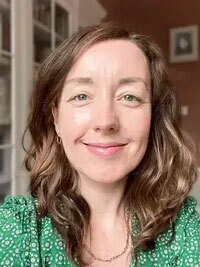
Carrie Gatestag:kylemore.nd.edu,2005:News/1846962026-08-13T09:27:00-04:002026-08-19T10:31:43-04:00The one thing you should know about Notre Dame DublinEimear Clowry Delaney, Michael J. Smurfit Director of Notre Dame Dublin
This story is part of Notre Dame Global's series titled "The One Thing."
In 2026, we are taking a new look at Notre Dame’s 12 global locations by asking each of their directors one question: “What is the one thing you would like the Notre Dame community to know about your programs, your achievements, your goals, or your aspirations?”
We focus now on Notre Dame Dublin, headed since 2024 by Eimear Clowry Delaney, Michael J. Smurfit Director, who joined the Keough Naughton Notre Dame Centre in 2008 and previously served as its senior associate director.
What is the one thing you want the Notre Dame community to know about Notre Dame Dublin?
“Student learning and teaching are at the core of everything we do.”
EIMEAR CLOWRY DELANEY: Notre Dame Dublin was founded in 1998—nearly 30 years ago. That is our origin story—we began as a student center, a learning center in Dublin. All of our current programs and collaborations spring from that history.
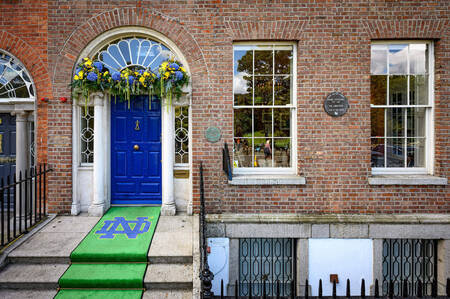
Front door of O’Connell House in Dublin, Ireland
Since the center’s founding, the Notre Dame students who come to Dublin have been the pathfinders in Ireland for the University as a whole and for its many collaborations with Irish society more broadly. The fifty or so undergraduates who come to us each semester for a study abroad experience attend classes—and are fully immersed—in one of three universities: Dublin City University, Trinity College Dublin, or University College Dublin. And, when one of us at O’Connell House encounters a potential partner or collaborator—if they've had an experience with our students—they are more than willing to engage with us. They trust us based on the experiences they've had with our young people—whether through one of the three universities or through one of our many internship placements during the semester or summer—at the National Gallery of Art or the Department of Foreign Affairs, for instance.
A beautiful, organic respect has been built for Notre Dame as an institution through these outstanding young people, from their desire to be in Ireland, their curiosity for the island they inhabit, and for their work during the time they're with us.
Why is that one thing—that student learning and teaching are at the core of everything you do—so important to Notre Dame Dublin?
“Making student learning and teaching central is how we engage with the purpose of a university—to educate and to inspire brilliant young minds to not only transform the world, but to transform how they see the world, how they feel in the world, and how they want to be in the world in the future.”
EIMEAR CLOWRY DELANEY: Our students come to us with ambition, curiosity, drive, creativity, and diverging opinions. That makes them brave, and these qualities make us brave, too.
Related to that bravery, one thing I am passionate about is that a part of studying abroad, researching abroad, and learning abroad is getting lost. If a program is too prescriptive, students aren’t able to see that while Ireland is an ancient island, we are also very advanced in today’s world. That can surprise some young people—but that can only happen if they are given the opportunity to explore, to get lost a bit, and go farther and deeper than one does with a typical tourist experience.
Professor Kevin Whelan teaches the poetry of W.B. Yeats as the students sit atop Knocknarea, County Sligo, on what is said to be ancient Celtic warrior goddess Queen Medb's Cairn, a 5,000-year-old neolithic passage tomb. The culture, landscape, and folklore in this area of Sligo, now known as "Yeats Country," was hugely influential to W.B. Yeats.
For that reason, here at Notre Dame Dublin, our core focus is building community, learning, and growing together through, as we say, “the soles of our feet.”
Our motto is Is ar scáth a chéile a mhaireann na daoine, an Irish proverb that translates to "People live in the shelter of each other,” reflecting our interconnectedness and reliance on community to survive and thrive.
The hundreds of students who have embraced this way of study abroad are a testimony to its effectiveness. One such student is Meera Baakta ‘26, who says, “In Dublin, I was able to explore questions similar to those across science and development that I studied at Notre Dame’s home campus, but within a different intellectual and social ecosystem. Connecting with professors and peers across courses such as Trinity College Dublin’s EthicsLab, I was able to expand my understanding of complex dilemmas and enrich my experience by learning alongside people formed by different histories and perspectives. I also began to learn the Irish language in classes at O’Connell House, and then continued my studies back on campus.” See Meera's story below
What does that one thing reveal about Notre Dame Dublin and Ireland overall?
“We Irish are a curious people, an island of people within a very small land mass who live in close proximity to each other. We build strong relationships within our own, sometimes parochial, communities. But we thrive in getting to know new people, and that curiosity—of wanting to interrogate, discuss, converse, or debate with others—is a very strong part of Irish culture.”
EIMEAR CLOWRY DELANEY: This quality of curiosity about how others think is at the core of who we are as a people. And, to be able to bring new people into the fold who may not think the same, that in itself is very Irish.
Curiosity works both ways. A key opportunity with international education is to understand that, wherever they claim citizenry, people are not really that different. The challenges we face are very much shared. With that realization comes a desire to problem-solve together. So, as a little island on the periphery of the Atlantic and of Europe, we Irish have traditionally felt rather isolated and alone. But now, Ireland has taken on a new identity—one of being a changemaker. We have a tiny population, but we have a very significant voice in the world. We will flourish and thrive only if we share that with the world and invite and welcome other people to be with us.
As part of the Translating Ireland Conference, University of Notre Dame professor Clíona Ní Ríordáin chaired the "Translating Irish Literature out of Ireland" panel discussion, which featured translators Marco Sonzogni (Victoria University, New Zealand), Marie Hermet (France), and Indrek Õis (Estonia).
Interrogating how Ireland has been a changemaker was one of the subjects of the “Translating Ireland” symposium Notre Dame Dublin hosted with several partners this past April to mark the 30th anniversary of the publication of the influential book by Michael Cronin, Translating Ireland. Led by Clíona Ní Ríordáin, the Thomas J. and Kathleen M. O’Donnell Chair in Irish Language and Literature, participants explored the central role translation played in the contact zone between languages as well as how it shaped the development of the languages of literature and the construction of identity in Ireland.
Looking ahead, I am very excited about an upcoming partnership within the University’s Arts Initiative between Notre Dame Dublin and Notre Dame Mexico. We are excited to make a joint announcement soon that will include all the details.
Learn more about the work of Notre Dame Dublin and the University of Notre Dame’s global network, or browse related articles:
Learn more about the collaborative work and partners of Notre Dame Dublin
The Legacy of Daniel O’Connell
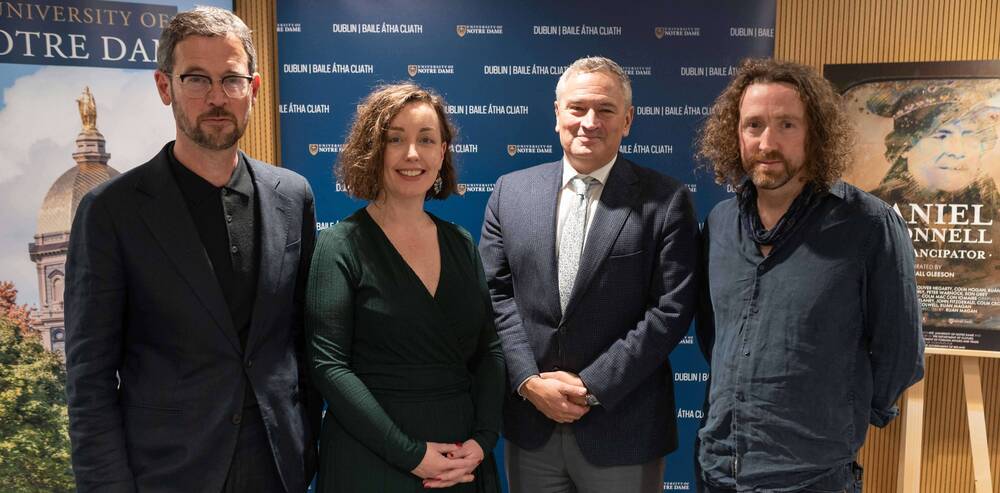
Eimear Clowry Delaney, Michael J. Smurfit Director of Notre Dame Dublin, attends the Daniel O’Connell: The Emancipator documentary premiere alongside (left to right) the documentary director Ruán Magan, University of Notre Dame Vice President & Associate Provost Michael Pippenger, and composer and musician Colm Mac Con Iomaire.
The Keough Naughton Notre Dame Centre at O’Connell House is the home of Notre Dame Dublin. Located at Number 58, Merrion Square, the centre was once home to the celebrated early nineteenth-century Irish Catholic political leader Daniel O’Connell.
O’Connell is the subject of a documentary titled Daniel O’Connell: The Emancipator, produced by Create One in association with the University of Notre Dame, University College Cork, and RTÉ, Ireland’s national television and radio broadcaster.
The documentary traces O’Connell’s journey from Kerry lawyer to global advocate for justice. Known as “The Liberator,” he secured Catholic Emancipation, pioneered non-violent mass political mobilization, and inspired democratic movements around the world.
The release of Daniel O’Connell: The Emancipator will form part of a four-year-long program of commemorations and research, from O’Connell’s 250th birthday in 2025 to the 200th anniversary of Catholic Emancipation in 2029, inviting audiences to reflect on how his vision for justice and democracy continues to shape our world.
The gala premiere of the documentary was held in Dublin in November 2025.
There will be a screening of The Emancipator on the Notre Dame campus Friday, November 13th, at the DeBartolo Performing Arts Center, and another screening at the Chicago Consulate Film Festival on Sunday, November 15th.
More than a Semester Abroad
Meera Bhakta, ‘26
Meera Bhakta ‘26 graduated with a major in science preprofessional studies and a minor in international development. During the spring 2025 semester, she studied at Trinity College Dublin and will return to Trinity this fall as a Naughton Fellow pursuing a masters of science degree in translational oncology.
MEERA BHAKTA: For my study abroad experience at Notre Dame, I explored programs from Santiago to Copenhagen, hoping there would be a clear sign pointing me in one direction. Eventually, I chose Trinity College Dublin because it allowed me to take a wide range of courses I was interested in and would allow me to fully integrate into a host university. At the time, I had researched Trinity extensively, but I knew relatively little about Ireland itself. Looking back, that is part of what made the experience so impactful. By not knowing, I was open to the surprises Ireland had in store for me.
In Dublin, I was able to explore questions similar to those I studied at Notre Dame across science and development, but within a different intellectual and social ecosystem. Connecting with professors and peers across courses such as EthicsLab, I was able to expand my understanding of complex dilemmas and enrich my experience by learning alongside people formed by different histories and perspectives.
Beyond the classroom, Dublin also impacted me through the people and communities I engaged with. Every Tuesday, I volunteered with an after-school program at St. Catherine’s Church through the Solas project. Some afternoons were spent helping with homework, others playing outside, organizing holiday activities, or sharing stories. Those Tuesdays filled my semester with an unexpected source of laughter and friendship, and taught me about allowing myself to be shaped by the people around me.
O’Connell House also became a valuable home base throughout the semester, providing a place for conversations, reunions with friends studying across the city, tea and digestive breaks, and opportunities to learn more about the Irish language, history, and culture. I began studying Irish through classes there, and then continued my studies back on campus.
I am so grateful to be returning to Dublin this fall with the support of the Naughton Fellowships to pursue an MSc in Translational Oncology at Trinity College Dublin. My time in Dublin helped me to see Ireland not just as a semester abroad, but as a place where I can continue to grow intellectually, personally, and professionally. I hope to continue studying the Irish language upon my return and plan to visit the Gaeltacht.
Imagallamh: the Keough-Naughton Summer School in Irish Studies
Declan Kiberd delivering a lecture to the graduate students attending Imagallamh, the Keough-Naughton Summer School in Irish Studies
A summer seminar for graduate students in the humanities is held every year in Ireland between Notre Dame Dublin and Notre Dame Kylemore.
Called “Imagallamh,” which means “mutual discourse,” the seminar seeks to emphasize the international and comparative elements of Irish studies. It also aims to bring the next cohort of scholars in the field into meaningful dialogue with one another and with key figures in Irish scholarship, the arts, and society. In addition to Notre Dame students, this year’s cohort included students from Britain, Canada, India, Ireland, Italy, Latin America, and the US. Each student received a fully-funded scholarship.
Directed by Barry McCrea, the Donald R. Keough Family Professor of Irish Studies and Professor of English at the University of Notre Dame, with the collaboration of Clíona Ní Ríordáin, the Thomas J. and Kathleen M. O’Donnell Chair in Irish Language and Literature, Imagallamh was launched in 2024 as a new iteration of the Keough-Naughton Institute’s IRISH Seminar, which ran from 1999 to 2022. That seminar was held in Ireland and locations around the globe, with such themes as Ireland and Britain, Classical Influences, Irish Modernisms, Ireland and Italy, and Peripheral Modernities: Ireland, Argentina, and Latin America.
The theme of the 2026 Imagallamh seminar was Urban Ireland. Across two weeks, students engaged with academics and writers to explore the historical, cultural, and literary dimensions of settlement on the island—from its earliest origins, including prehistoric settlements, early monastic complexes, Viking towns, and British garrisons, through to the life of Ireland’s modern cities.
Some highlights of the Dublin week of the seminar included lectures on Sean O’Casey and the development of Dublin’s built environment from the Georgian city through independence, an interdisciplinary conversation between leading Dublin architects and poets, and a trip to the Tenement Museum on Henrietta Street.
Originally published by Mary Hendriksen at global.nd.edu on August 11, 2026.
]]>
Mary Hendriksentag:kylemore.nd.edu,2005:News/1829252026-07-07T14:03:29-04:002026-07-07T14:03:29-04:00Notre Dame Arts Initiative awards over $400,000 for community and campus partners to lead inaugural Arts Biennial programming
The Notre Dame Arts Initiative has awarded 38 grants to foster sustained growth in the arts through partner programming for the inaugural Notre Dame Arts Biennial, scheduled for January through June of 2027. Awardees include 16 regional community partners, 19 campus units, and four Notre Dame Global locations, with another 60 campus units and external organizations involved as collaborators. In addition to funding, partners receive administrative support from Arts Initiative staff for planning, implementation, and promotion.
Projects include theatrical premieres, regional dance and music festivals, multimedia installations, visual art and architecture exhibitions, high-impact arts education programs, international artistic exchange, and more. Biennial programming is open to the public, and events will be held on Notre Dame’s campus, in and around South Bend, and at select global locations.
Occurring every two years, the biennial is an international arts festival rooted in the creative spirit, intellectual energy, and iconic traditions of Notre Dame and the region. Predominantly free programming across the visual, spatial, literary, and performing arts will contribute to the region’s long-term flourishing by enhancing quality-of-life and quality-of-place and by providing new platforms for arts research to positively impact the public.
In his inaugural address, University President Rev. Robert A. Dowd, C.S.C., urged the Notre Dame community to be builders of bridges to live out our mission as a leading global Catholic research university. The biennial is one of the most visible ways the Arts Initiative is responding to that call.
“This scale of coordination and collaboration is unprecedented,” said Michael Schreffler, director of the Notre Dame Arts Initiative. “We are grateful to all of our partners for bringing their energy and leadership to fully realize the vision of the biennial’s inaugural theme of symbiosis: a call to contemplate mutually-beneficial relationships through the arts and create them together in practice.”
Community partners leading biennial programming reflect the strength and diversity of arts and culture across the region. Participating regional community partners include:
Abby Marchesseault Dance Collective
Acting Ensemble
Equity in the Arts, an initiative of South Bend Venues Parks & Arts
Goshen College Music Center
Fischoff National Chamber Music Association
The History Museum
Lubeznik Center for the Arts
Merrimans’ Playhouse
New Industry Dance
Performing Media Festival, produced in partnership with IU South Bend
Saint Mary’s College, Department of Art
South Bend Civic Theatre
South Bend Community School Corporation
South Bend-Elkhart Regional Partnership
South Bend Museum of Art
South Bend Symphony Orchestra
Campus units awarded funding for partner programming similarly span artistic media and represent a University-wide commitment to interdisciplinary innovation. In addition to projects housed in arts departments, campus efforts are also being led by the College of Science, Hesburgh Libraries, the School of Architecture, and a range of interdisciplinary centers and institutes.
Beyond robust support for partner projects, the biennial also closes gaps in cultural access by attracting prominent artists to the region and making the highest-caliber arts experiences available to the public. In addition to world-class artists hosted by the Arts Initiative, signature performances, convenings, and exhibitions aligned with the biennial’s inaugural theme will be hosted by the DeBartolo Performing Arts Center, the Franco Family Institute for Liberal Arts and the Public Good, and the Raclin Murphy Museum of Art.
A dual emphasis on local and visiting artists is a hallmark of Notre Dame’s biennial. “We’re not aware of any other U.S. university currently curating a biennial of this nature and scale,” said Rebecca Struch, Arts Initiative managing director. “Establishing a groundbreaking biennial in northern Indiana, a place with an evolving but often overlooked arts scene, will advance the region as a global gathering place for arts and inquiry.”
“The Notre Dame Arts Biennial reflects what’s possible when our community and local institutions work together,” said South Bend Mayor James Mueller. “This effort will activate our public spaces, support local artists, and strengthen the connections that make South Bend a vibrant place to work and live.”
The Arts Biennial launches at a pivotal moment for the arts across the region and on campus. Informed by its Catholic character, the University’s most recent strategic framework identifies the arts as a key priority and calls for deeper engagement with South Bend and the region. The South Bend-Elkhart region also recently adopted a new Arts & Culture Plan. The biennial builds on these developments by nurturing the arts as a shared community asset that strengthens social bonds and shapes place-based identities.
Contact: Rebecca Struch, Arts Initiative managing director, 574-631-9845, rstruch@nd.edu
Originally published by Arts Initiative at arts.nd.edu on July 06, 2026.
]]>
Arts Initiativetag:kylemore.nd.edu,2005:News/1828652026-07-06T12:27:00-04:002026-07-06T12:27:05-04:00In Memoriam: Trustee Emeritus Martin NaughtonMartin Naughton
Martin Naughton, a member of the University of Notre Dame’s Board of Trustees since 1999 and chairman emeritus of the supervisory board of the Irish manufacturing firm Glen Dimplex Group, died July 4. He was 87.
“Martin was a celebrated business leader, a transformative philanthropist, a devout Catholic, a devoted husband and father and a cherished friend to many who today mourn his passing,” said University President Rev. Robert A. Dowd, C.S.C. “Notre Dame would not be the preeminent American university in Ireland today without his incredible vision and generosity and that of his wife, Carmel, and their family. My deepest condolences and prayers are with Carmel, their children and all who knew and loved Martin. May he rest in peace.”
Born in Dundalk, County Louth, Naughton studied mechanical and production engineering at the Southampton College of Technology, qualifying as an engineer in 1961. After 12 years as an industrial engineer and plant manager, he founded a small electrical appliance company, Glen Electric. Four years later, he acquired the much larger British heating company Dimplex and renamed the new firm Glen Dimplex.
Naughton continued to make acquisitions over the next 40 years, making Glen Dimplex today one of the world’s major manufacturers of domestic appliances with headquarters in County Louth, Ireland, operating in 20 countries and with more than 8,000 employees.
Naughton’s support of Notre Dame initiatives in his home country was substantial. He contributed to chaired professorships, faculty fellowships and the expansion of the Keough Institute for Irish Studies. Established in 1992 with a gift from the late Donald Keough and his wife, Marilyn, the institute was renamed in 2006 — at Keough’s urging — as the Keough-Naughton Institute. The institute is dedicated to the study and understanding of Irish culture in Ireland and beyond, with a wide-ranging focus on history, language, literature and policy.
Naughton was also instrumental in Notre Dame establishing its Keough-Naughton Notre Dame Centre at the historic O’Connell House on Merrion Square in Dublin. He was a founding member of the University’s Ireland Council and, in 2008, created the Naughton Fellowship Program, in which Irish students come to Notre Dame to study and conduct research in the STEM fields and Notre Dame students participate likewise in Ireland.
In one of his last acts, the late Pope Francis conferred the honor of the Order of Saint Gregory the Great upon Martin and Carmel Naughton in 2025. The papal honor commended the Naughtons’ philanthropy in education and the arts, recognizing in particular their support of Catholic education at Notre Dame and Kylemore Abbey and their contributions to higher education in Ireland.
The University paid tribute to Naughton’s many contributions by bestowing on him an honorary degree in 1998 in a ceremony that marked the opening of the study center in Dublin. He also received honorary degrees from Trinity College Dublin, University College Dublin, Queen’s University in Belfast, the University of Ulster Coleraine, Dublin City University and Griffith College Dublin.
Naughton served for seven years on the Irish Council of State and was chair of Intertrade Ireland and the North-South Body for Trade and Business. He also was a member of the advisory board for Citi Group Private Bank for Europe and the Middle East.
The Naughton Foundation, established in 1994, supports worthwhile causes in the arts and education and, since 2008, has offered scholarships to students pursuing STEM-related studies. He founded the Naughton Art Gallery and Museum at Queen’s University, Belfast, as well as other initiatives at the university. He was the main benefactor to the Lyric Theatre in Belfast.
Naughton was appointed a Knight of the British Empire and an Officier de la Legion d’Honneur of France.
Naughton is survived by Carmel; their children, Neil, Fergal — a Notre Dame Hesburgh Trustee — and Fiona; and their extended family.
Arrangements are pending.
Originally published by Notre Dame News at news.nd.edu on July 05, 2026.
]]>
Notre Dame Newstag:kylemore.nd.edu,2005:News/1813522026-05-04T08:15:00-04:002026-05-04T08:15:43-04:00International partners boost peace agreement success, Notre Dame study finds
Over the past 50 years, nearly 4 in 10 peace agreements have failed within five years of signing. New research shows that when international partners help implement an accord, the odds improve — and the deeper their engagement, the better.
Colombia’s 2016 peace accord ended over 50 years of armed conflict. It has had high levels of global support, from negotiation to implementation. Photo by Gobierno de Chile (Government of Chile), CC BY 2.0, via Wikimedia Commons.
That’s according to a study by University of Notre Dame researcher Madhav Joshi. The study, published in the Journal of Intervention and Statebuilding, shows how the visible, on-the-ground presence of partners such as foreign countries, multilateral institutions and policy advocacy organizations keeps peace agreements on track by raising reputational costs for leaders who fail to implement them.
Joshi’s research drew on evidence from the historic 2016 Colombian peace accord between the government and the Revolutionary Armed Forces of Colombia-People’s Army (FARC-EP), which illustrates these dynamics in practice.
The Colombian agreement has had high levels of global involvement, from negotiation to implementation. More than 30 international actors have helped support the agreement, including the European Union, the United Nations Development Programme, the Carter Center and the U.S. government.
Joshi used data from the Peace Accords Matrix Barometer Initiative, which is responsible for monitoring and verifying implementation of the accord. This is the first time a university-based research center has played such a direct role in supporting the implementation of a peace agreement, and the first time researchers have measured the implementation of a peace accord in real time.
Drawing on this data, Joshi tracked 578 individual commitments from December 2016 through April 2023. He found that international support, and the depth of that support, directly improved implementation outcomes.
Previous research has shown that domestic leaders often fail to implement peace agreements either because they are politically costly or because leaders lose domestic political support. Joshi found that international partners bring expertise and resources to support the aspects of agreements that are most at risk. Crucially, he also found that partners’ involvement increases the visibility of these agreements. That motivates leaders to work through obstacles rather than risk losing face on the global stage.
“When domestic actors face higher reputational costs, they are less likely to shirk their commitment to implementing peace,” Joshi said.
Colombia’s story reflects these findings, Joshi said. When Iván Duque won the Colombian presidency in 2018 by rallying voters against the peace agreement, extensive international involvement meant he couldn’t walk away from it, despite his campaign promise.
Informing global peace policy and practice
Joshi’s research examines why peace agreements succeed or fail. These insights are an important part of the Peace Accords Matrix and its ongoing work to inform frontline policymakers and practitioners.
The new study builds on Joshi’s broader body of work, which examines why peace agreements succeed or fail. Previous research has explored how partial agreements can pave the way for more comprehensive deals and how addressing gender issues strengthens accords.
Joshi’s work plays a central role in the Peace Accords Matrix. It maintains the world’s largest collection of implementation data on intrastate peace agreements, informing the work of policymakers and practitioners.
The latest study carries direct implications for how future agreements are designed, Joshi said, adding that partners should be built into strategies from the start.
“To maximize the chances for success, negotiators should design strategies to incorporate partners before the agreement is signed and deploy them as soon as implementation begins,” Joshi said.
Contact: Tracy DeStazio, associate director of media relations, 574-631-9958 or tdestazi@nd.edu
Originally published by Josh Stowe at keough.nd.edu on April 28, 2026.
]]>
Josh Stowetag:kylemore.nd.edu,2005:News/1807742026-04-14T07:38:00-04:002026-04-14T07:38:39-04:00Statement from University President Rev. Robert A. Dowd, C.S.C., in support of Pope Leo XIV
“Pope Leo XIV continues to proclaim the Gospel of Christ by upholding human dignity and serving as a tireless advocate for peace. His message transcends partisan political divisions in this or any country and I’m deeply grateful for Pope Leo’s inspiring example. I ask members of the Notre Dame community to pray for peace and work together with all people of goodwill to build a more just and humane world.”
Rev. Robert A. Dowd, C.S.C. President, University of Notre Dame
Originally published by Notre Dame News at news.nd.edu on April 13, 2026.
]]>
Notre Dame Newstag:kylemore.nd.edu,2005:News/1803572026-03-27T12:45:00-04:002026-03-27T12:45:42-04:00Notre Dame Department of Theology ranked best in the world for second consecutive year
The University of Notre Dame has again been ranked as the world’s best theology, divinity, and religious studies program by the influential QS World University Rankings. This is the second consecutive year and the fifth time since 2020 that the Department of Theology has received the No. 1 distinction.
The ranking is based on academic reputation, employer reputation, and research impact. Out of 150 universities included, Notre Dame’s score of 92.2 bested the University of Oxford (89.2), Harvard University (89.1), Durham University (88.7), and Boston College (88.3).
“To be ranked No. 1 in the world for two years in a row is a momentous accomplishment for which all our faculty and staff deserve great credit,” said Fr. Khaled Anatolios, the John A. O’Brien Professor of Theology and chair of the department. “As a department, we take the measure of our own performance less from external rankings than from fidelity to our mission. Nevertheless, these consistently top rankings demonstrate that our fidelity produces scholarly results that are literally second to none in commanding international admiration.”
In addition to offering a doctorate and four master’s degree programs, Notre Dame’s theology department maintains a strong commitment to undergraduate education by supporting more than 800 theology majors or minors and teaching the theology courses that all Notre Dame students take as part of the University’s Core Curriculum.
Originally published by Arts & Letters at al.nd.edu on March 26, 2026.
]]>
Arts & Letterstag:kylemore.nd.edu,2005:News/1801252026-03-19T08:21:00-04:002026-03-19T08:21:29-04:00Irish-Language Academic Conference at Notre Dame London First of Its Kind in the UKConference delegates at Notre Dame London
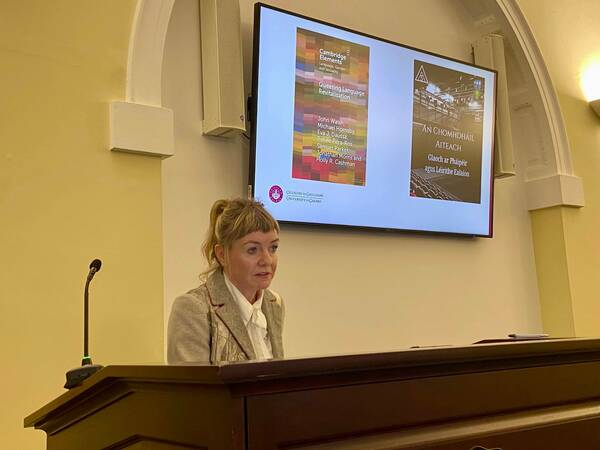
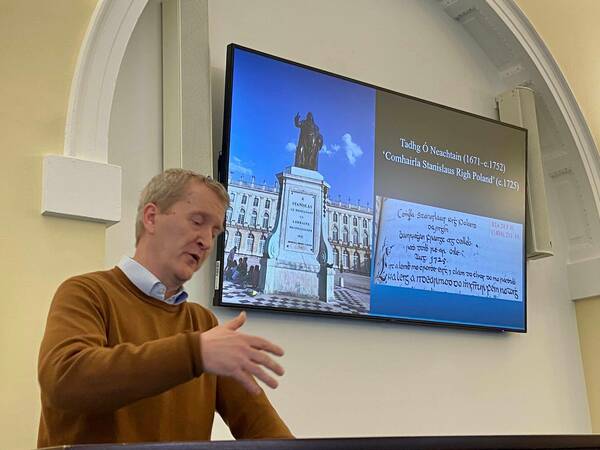
Leading scholars of the Irish language from across Europe and North America gathered in central London last week for In ÉiNDí 2026, an academic seminar conducted entirely in the Irish language and hosted at Notre Dame London.
According to the seminar’s organizer, Brian Ó Conchubhair, Professor of Irish Language and Literature at the University of Notre Dame, the gathering is an important moment for Irish-language scholarship in Britain.
“To our knowledge, this may be the first academic conference hosted in the UK that is conducted entirely through Irish,” Ó Conchubhair said. “It reflects the growing international community of scholars who use Irish as a language of research and intellectual exchange.”
Hosting the seminar in London reflects the global reach of Irish-language scholarship. As an international center for the study of Ireland and its language, the University of Notre Dame has long played a leading role in advancing Irish studies beyond Ireland. In ÉiNDí 2026 represents an example of this commitment, bringing scholars together in a global setting to strengthen Irish as a language of research and intellectual exchange. The seminar's organizer, Brian Ó Conchubhair is a fellow of the Keough-Naughton Institute for Irish Studies in the Keough School of Global Affairs and a leader of the Irish Language Initiative in Notre Dame’sCollege of Arts and Letters.
Prof. Rióna Ní Fhrighil, University of Galway, presenting at In ÉiNDí 2026
The two-day seminar featured keynote lectures from leading Irish-language scholars, including Máire Ní Mhaonaigh of University of Cambridge, Pádraig Ó Siadhail of University of St Mary’s University Halifax, and James Little of the University of Cyprus. Presenters also included scholars from universities across Ireland and beyond, with representatives from every major Irish university participating in the programme.
Beyond textual scholarship, the seminar also explored how Irish-language sources can be used for deeper understanding of broader social and historical questions. Presentations examined topics ranging from the emotional lives reflected in medieval texts to Irish-language responses to global political issues, including reactions to apartheid in South Africa. These topics show that the Irish language has always been a medium for responding to global human rights issues and internal psychological states.
The seminar also addressed contemporary concerns facing Irish-speaking communities. For example, sessions explored topics such as language use in healthcare settings and the ways in which Irish speakers navigate both Gaeltacht (Irish-speaking) communities and the wider English-speaking world.
Prof. Fionntán de Brún, Maynooth University presenting at In ÉiNDí 2026
Discussions highlighted how the field is evolving to reach new generations of scholars and students. Digital tools and resources, such as the Electronic Dictionary of the Irish Language (eDIL), are making centuries of Irish-language material more accessible, helping to connect traditional Irish Studies with the research habits and expectations of a digital-native Generation Z.
“The timing of the event in 2026 is a significant milestone,” said Ó Conchubhair. “With sessions tracing the history of Irish programs from 1972 to 2026, the seminar offers a moment to reflect on more than fifty years of institutional progress. It is both a celebration of survival and an opportunity to think strategically about the future of the language in a globalized world, ensuring that Irish remains a vibrant, intellectual, and research-driven language on the world stage.”
Learn more about Irish Language Initiatives at Notre Dame.
Originally published by Joanna Byrne at london.nd.edu on March 17, 2026.
]]>
Joanna Byrnetag:kylemore.nd.edu,2005:News/1801242026-03-19T08:20:00-04:002026-03-19T08:20:15-04:00Shared histories of India and Ireland illuminated at Notre Dame conference in Delhi
An international group of scholars gathered last week at Miranda House, University of Delhi, in India’s capital city for a series of roundtables dedicated to the theme of “India and Ireland: Shared Histories and Interconnected Pasts.”
The gathering was organized by Jill Bender, visiting associate professor at the Keough-Naughton Institute for Irish Studies in the University of Notre Dame’s Keough School of Global Affairs and associate professor of history at the University of North Carolina at Greensboro; Dhiraj Mehra, director for initiatives in India for Notre Dame Global; and Miranda House faculty members Sneh Jha and Ms. Madhu. The event drew remarkable support and interest from students and faculty of the host college, an international cohort of speakers, and the Embassy of Ireland, India.
Ambassador of Ireland to India Kevin Kelly speaks at Miranda House.
Irish Ambassador to India Kevin Kelly inaugurated the proceedings with a reception at his official residence on the evening of March 9, followed by opening comments the next morning. In his remarks, Kelly acknowledged how the relationship between India and Ireland has been “created and complicated by colonialism” and by their respective relationships to Great Britain. The focus of the academic gathering, however, was on the many direct links between Ireland and India and on the movement of people from one country to the other throughout their shared histories. The ambassador added that the diasporas of both nations have been a source of strength for them at a global level and welcomed participants as they prepared to share research, artwork, and historical projects that examine the complex connections between the two countries.
The colloquium’s researchers took on the organizers’ call to illuminate both popular and lesser-known aspects of Indian and Irish ties. In recent years, scholars have not only explored these links as parallel experiences, but also as shared experiences — recognizing how these connections or networks were forged and maintained and emphasizing the ways in which these relations were mutually constituted and informed by distinct but analogous experiences of British rule. Comparative work, in particular, allows us to examine or question accepted paradigms and draw conclusions about shared human experiences across geographical space and time.
The papers presented at Miranda House built on this scholarship in meaningful ways and promised to take our understanding of the Irish-Indian connections in new directions. Scholars from universities in India, Ireland, and the United States offered a range of insights on several major themes that reveal connections stretching beyond the confines of the traditional roundtable format.
A student asks a question during “India and Ireland: Shared Histories and Interconnected Pasts.”
Several presenters brought seldom-heard voices to the forefront by examining the experiences of South Asian laborers in Ireland, the experiences of Irish individuals in South Asia, and the shared experiences of Irish and Indian people in Britain or under British colonial rule. For example, Catherine Healy (EPIC, The Irish Emigration Museum) examined Irish and Indian domestic servants in British households, Mark Doyle (Middle Tennessee State University) looked at South Asians in 18th- and 19th-century Ireland, Arthur Duff (WEFT Foundation) presented on Irish Presbyterians in India, Jay Roszman (University College Cork) portrayed educated Catholics in the imperial system, and Arunansh Goswami (Scindia Research Centre) discussed Irishmen serving in the Maratha ranks.
Across several roundtables, delegates highlighted female voices and the role of gender in shaping Irish-Indian networks and engagements. In this effort, Jane Ohlmeyer (Trinity College Dublin) highlighted non-elite Irish women and biracial children in India to challenge the notion that empire was a predominantly male space, and Jyoti Atwal (Jawaharlal Nehru University) and M. Satish Kumar (Queen’s University Belfast—GIFT City Campus) examined notable female Irish activists in India: Margaret Cousins and Margaret Noble, respectively.
Other papers inquired into the various methods of control and displays of power employed in both Ireland and India, and the lasting, often traumatic, repercussions of these practices. Of note in this vein, Jill Bender (University of Notre Dame/University of North Carolina at Greensboro) examined Sir Hugh Rose’s efforts to introduce military reforms in Ireland based on his experience in India; Pushkar Sohoni (IISER Pune) compared architectural styles as strategies of empire and assertions of power; and Sucheta Mahajan (Jawaharlal Nehru University) discussed memory work in the aftermath of partition.
From left, Kristin Mahoney of Michigan State University speaks during a panel with Jyoti Atwal of Jawaharlal Nehru University and M. Satish Kumar of Queen’s University Belfast–GIFT City Campus.
The theme of partition, alongside Tom Bartlett’s (University of Aberdeen) paper on Irish recruits to India from 1750-1830; Patrick Griffin’s (University of Notre Dame) discussion of Lord Cornwallis and his comparative interests in America, India, and Ireland; and Robert O’Sullivan’s (University of Notre Dame) comments on the Irish-American press’s reporting on the 1857 Uprising recognize that the connections between Ireland and India, and their shared experiences under colonial rule, had an impact on and far beyond the shifting borders of the two countries.
Finally, Kristin Mahoney’s (Michigan State University) study of Æ and theosophy, Projit Mukharji’s (Ashoka University) paper on artist Frank Leah, and Irish artist Michelle Boyle’s exploration of intersections between identity and landscape revealed that the engagement between Ireland and India — and the often conflicted sense of identity that could accompany it — surfaced in other modes of creative expression and could shape one’s experience with the natural and spiritual worlds.
Together, these presentations made clear that studying the “Shared Histories and Interconnected Pasts” of Ireland and India promises not only to continue to tell us much about both countries, but also to shed light on broader topics, such as migration, violence, gender, empires, decolonization, language, education, hunger, and, even, love.
“India and Ireland” participants visit the Viceregal Lodge in Delhi.
Hosts and cultural activities
The host institution for the gathering was Miranda House, an all-women’s college at the University of Delhi.
Faculty and students from the college’s History Society welcomed participants to their distinctive brick campus, a quiet refuge in the heart of Delhi’s university district. Miranda House, founded in 1948, shortly after India’s independence, aspires to steer its women towards introspection and self-learning that will help them lead with global social issues in mind. This gathering drew a large audience of students and faculty, all eager to participate in the event’s organization and contribute with thoughtful questions and comments as the panelists shared their research.
Jill Bender, visiting associate professor at the Keough-Naughton Institute, teaches a workshop at Miranda House.
As a special addition to the meetings, several female delegates from Ireland and the United States offered a workshop on comparative women’s history to a full classroom of Miranda House participants. According to organizer Jill Bender, “It was an absolute delight to meet with the students of Miranda House. Their thoughtful and intelligent questions suggest a promising future for Irish-Indian academic engagement.” Bender gave special thanks to the History Society’s faculty advisers who served as co-organizers, Sneh Jha and Ms. Madhu, and to the many students who served as moderators, time-keepers, facility hosts, and campus guides.
After the two-day proceedings at Miranda House, international visitors took advantage of their time in Delhi to explore several of the city’s monuments and sites that are intimately linked to the Irish experience in India. First was a guided tour of the Viceregal Lodge, residency for five viceroys during British rule, current offices of the vice-chancellor of the University of Delhi, and home to an extensive archive that includes a permanent photography exhibit of the Uprising of 1857. The group also visited Coronation Park, site of several coronation Durbar celebrations; Flagstaff Tower, an important site during the Uprising of 1857; the Maidens Hotel, a colonial heritage landmark; and Nicholson Cemetery, which holds the remains of Brigadier-General John Nicholson along with Irish, English, and Scottish Christian residents of Delhi. Many participants made personal visits to Delhi’s top historical and cultural sites associated with their areas of study, including the Red Fort, the Partition Museum, India Gate, and the Mahatma Gandhi Memorial Park.
This gathering of international scholars is only the beginning of the formation of deep connections among its distinguished participants. Thanks to the support of the Keough-Naughton Institute for Irish Studies, Notre Dame Global, and Miranda House, this group of researchers was able to “practice what they preach” by contributing to global, comparative collaboration.
Originally published by Adam Winkel at irishstudies.nd.edu on March 18, 2026.
]]>
Adam Winkeltag:kylemore.nd.edu,2005:News/1801222026-03-19T08:19:00-04:002026-03-19T08:19:21-04:00Notre Dame announces that families with incomes under $150,000 will pay zero tuition
The University of Notre Dame today announced significant enhancements to its undergraduate financial aid program, marking a bold expansion of the Pathways to Notre Dame initiative.
Beginning in the 2026-27 academic year, Notre Dame will ensure that families with annual income below $150,000 will receive need-based financial aid that covers the cost of tuition. Families with income below $200,000 will receive need-based aid that covers half the cost of tuition. In addition, most students from families with annual income below $60,000 will receive need-based financial aid that covers tuition, fees, housing and food. This announcement reflects the University’s long-standing commitment to ensure a Notre Dame education is affordable and accessible to students from all socioeconomic backgrounds, and this expansion of Pathways to Notre Dame provides the clarity that families need during the admissions process.
University President Rev. Robert A. Dowd, C.S.C., launched the Pathways to Notre Dame initiative in his September 2024 presidential inauguration speech, when he announced that Notre Dame would be need-blind and loan-free for all students, domestic and international. “In order to be the community of learning we are called to be, cost must never be a barrier. By expanding the Pathways to Notre Dame program with this announcement, we continue to make strides to make a Notre Dame education more affordable," Father Dowd said. "We are committed to making every effort to welcome talented young people from a variety of backgrounds to a Notre Dame community that will help them to develop their gifts. I have no doubt that the students who come to Notre Dame thanks to Pathways will enrich our community in every way.”
“I am grateful that Notre Dame is expanding the Pathways to Notre Dame program,” said Micki Kidder, vice president for undergraduate enrollment. “With this announcement, we reiterate our unwavering commitment to ensuring that cost will never be a barrier between a promising student and a Notre Dame education, and we are ensuring that families have greater clarity as they consider this important and formative step for young scholars. Navigating the financial aid process can often feel like the most daunting part of the college selection journey. By implementing income-based scholarship thresholds, we are providing the clarity families need to see that a world-class education is within their reach.”
As the preeminent global Catholic research university, Notre Dame remains dedicated to every member of its community. Notre Dame will continue to meet 100% of demonstrated need for all admitted students, both domestic and international. For the past three decades, Notre Dame has provided significant need-based scholarship support to meet families’ full financial need. However, the Pathways to Notre Dame program expands the University’s commitment to affordability in historic ways. In the next four years, supported by the generosity of many members of the Notre Dame family, the University’s undergraduate financial aid commitment will exceed $1 billion.
Originally published by Media Relations at news.nd.edu on March 18, 2026.
]]>
Media Relationstag:kylemore.nd.edu,2005:News/1799032026-03-11T15:41:00-04:002026-03-11T15:41:18-04:00Notre Dame Global in Photos: February 2026
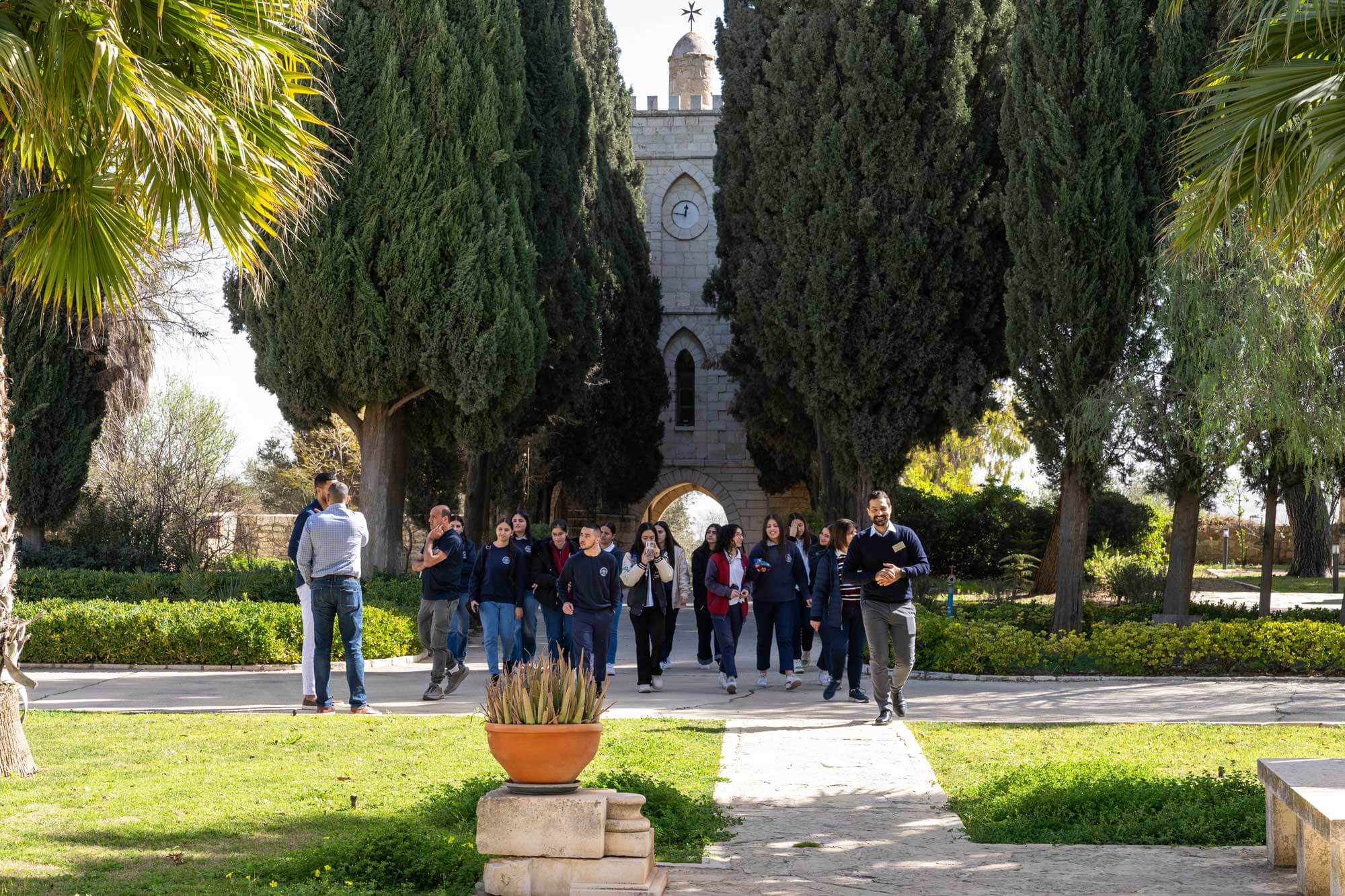
February offered a clear snapshot of the reach of Notre Dame’s global engagement. Alumni leaders gathered in Mexico to deepen connections across Latin America, while conversations and visits in Hong Kong and across India highlighted expanding opportunities for academic partnership. Students took part in immersive cultural experiences in Beijing, Dublin, Rome, and London. In Jerusalem, local school groups visited Notre Dame's academic center to explore the University’s programs and its commitment to need-blind admissions. In South Bend, international students connected intercultural learning with service to the local community, while Notre Dame’s international scholars reflected on the life and legacy of Rev. Theodore Hesburgh, C.S.C. Together, these moments reflect a university continually extending its mission through relationships, discovery, and shared purpose around the world.
This photo gallery highlights some of the valuable interactions and experiences Notre Dame faculty, staff, and students have taken part in over the past month.
The selection was curated by Notre Dame Global staff working on campus and in the University's 12 global locations.
Mexico
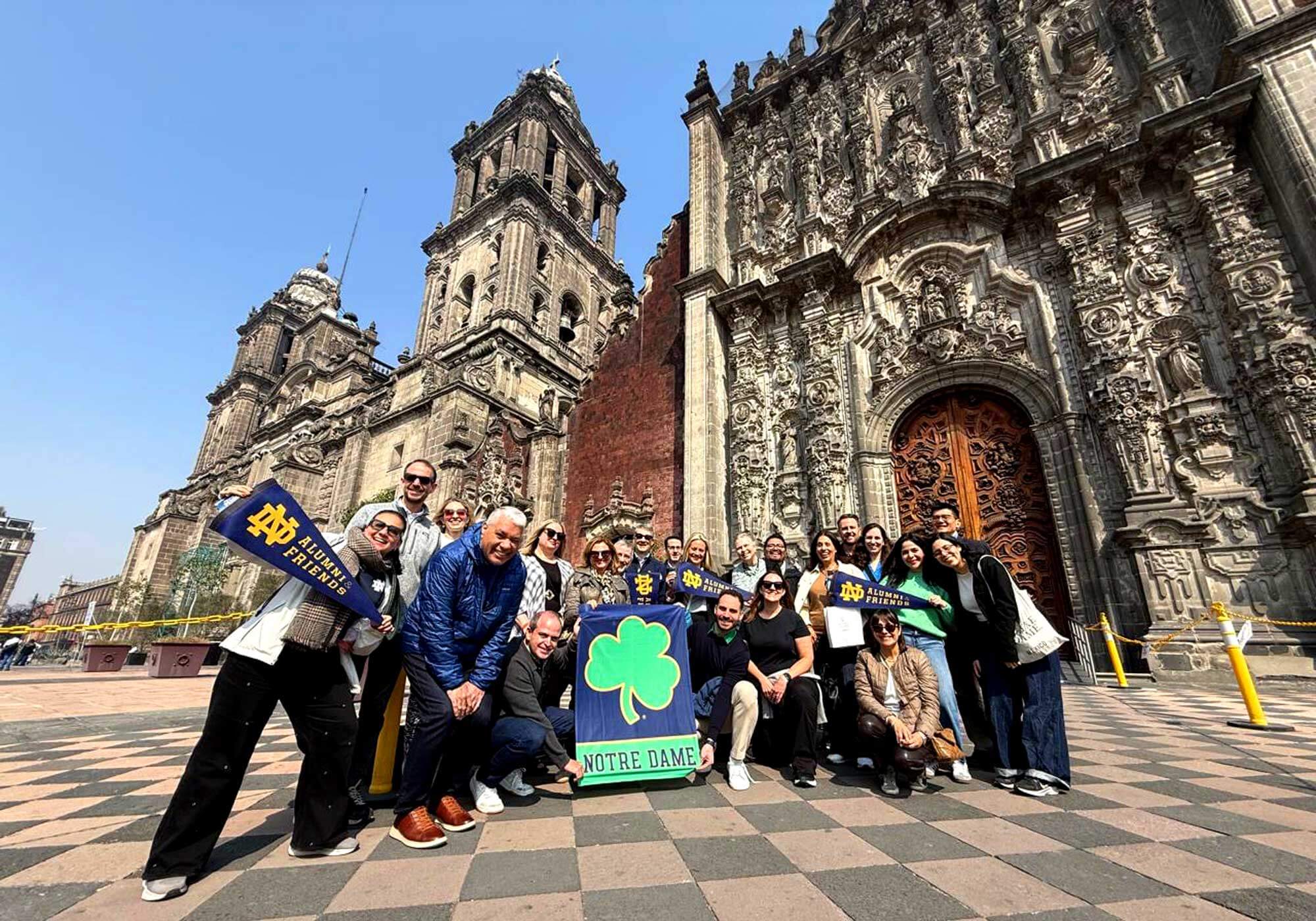
Notre Dame Mexico hosted the Notre Dame Alumni Association's Latin America & Caribbean Regional Meeting, convening club leaders and university partners from across the region. Representatives from nine countries gathered to strengthen alumni engagement, share campus updates, and advance regional collaboration. University leaders—including two deans and many colleagues from Notre Dame's colleges and schools—reinforced Latin America’s strategic importance to the Notre Dame community. The three-day meeting combined strategic dialogue with cultural experiences, fostering new pathways to advance the University’s global mission.
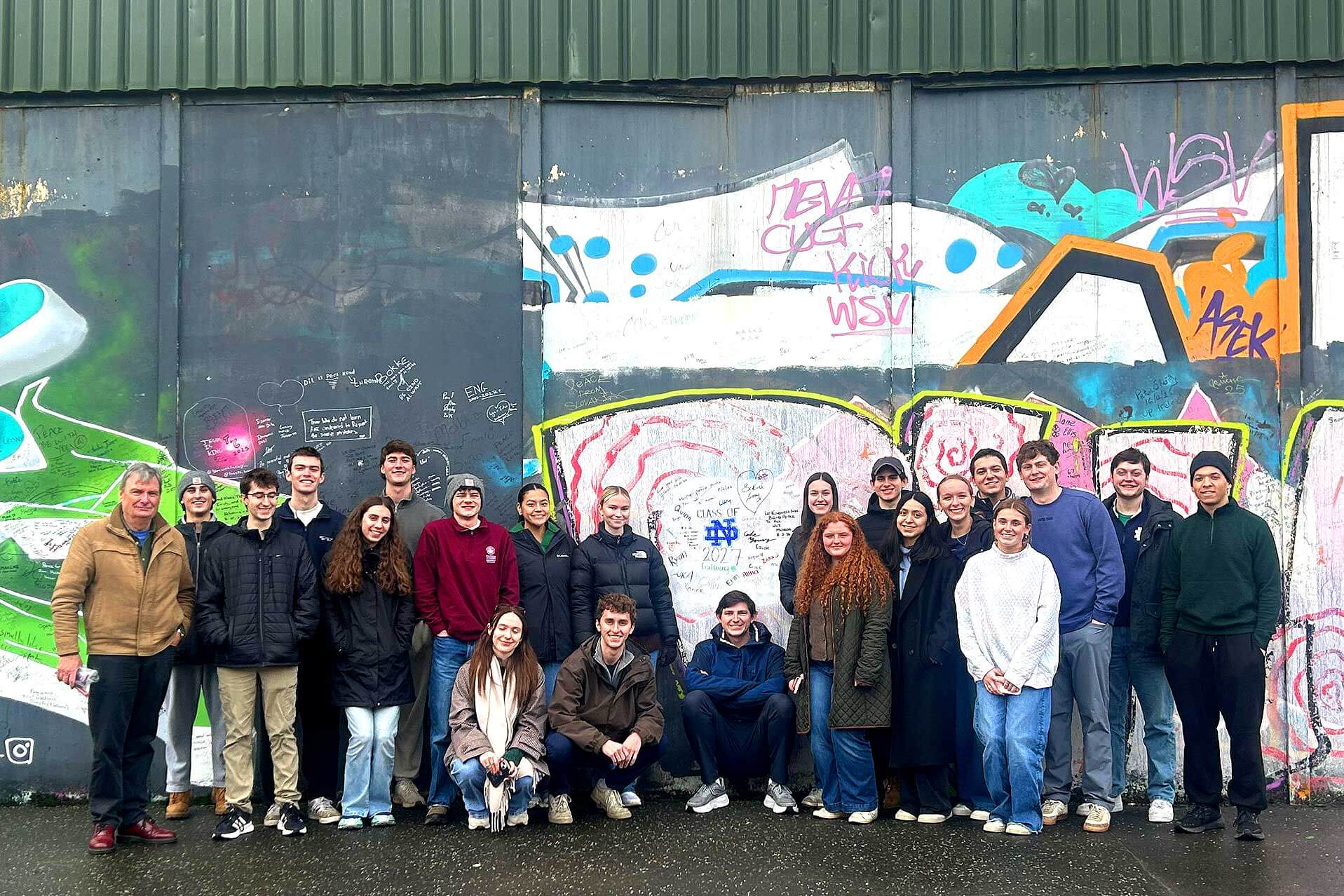
Notre Dame Kylemore spring study abroad students visited Northern Ireland, exploring Derry, Giant’s Causeway, Ballycastle, and more. In addition to excursions like this, students who are part of the Galway program have the unique opportunity to conduct international research in a live lab at the University of Galway.
Beijing
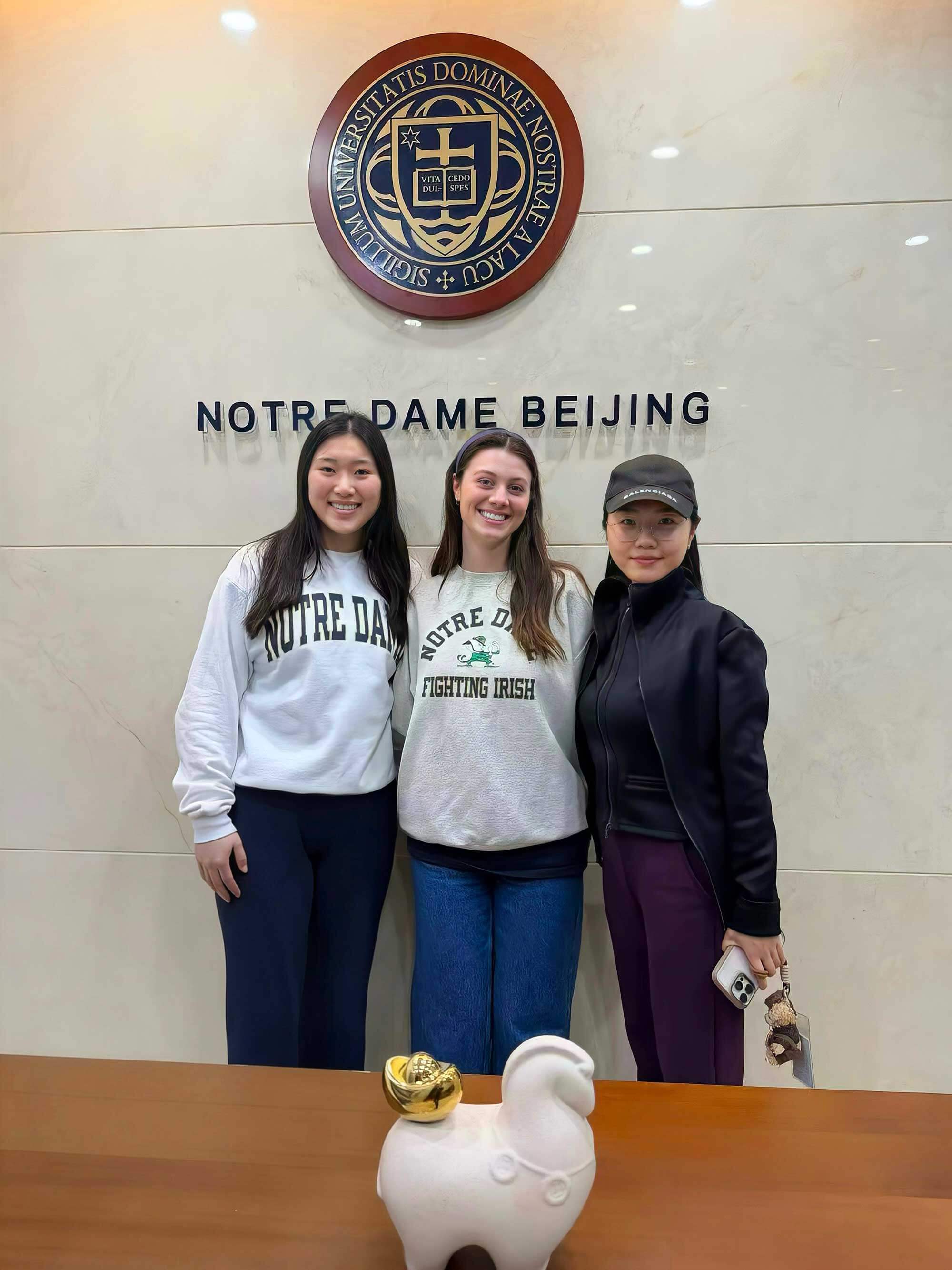
Notre Dame Beijing welcomed Notre Dame undergraduate students for the spring semester. Students in the Beijing program take courses at two top-10-ranked universities in Asia—Peking University (PKU) and Tsinghua University—as well as at The Beijing Center (TBC), which offers a distinctive experience in Chinese culture with a focus on education and fostering multicultural connections guided by the Jesuit tradition.
Dublin
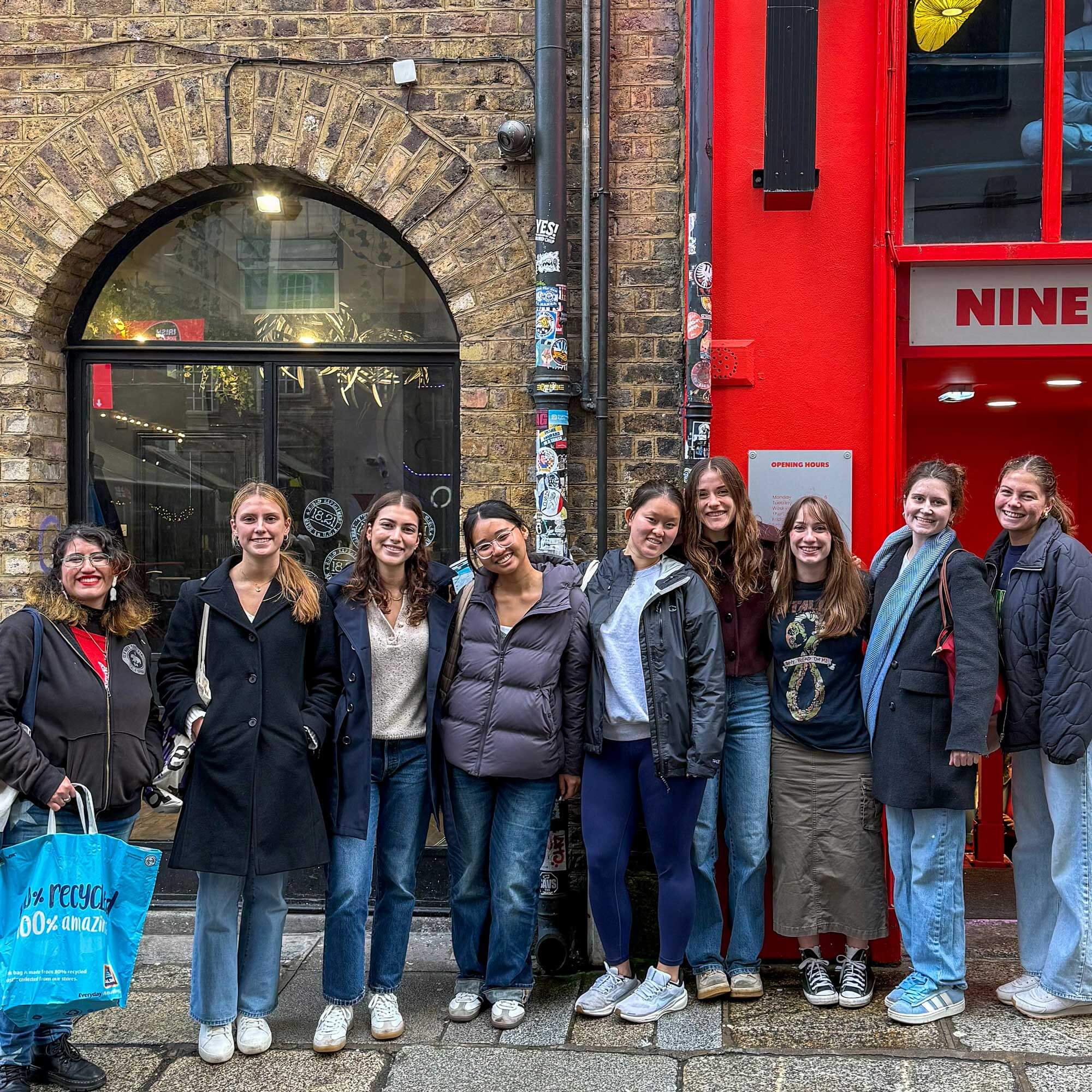
Students joined the Notre Dame Dublin team on a second-hand book and thrift-store crawl. These immersive adventures led study abroad students around the city of Dublin to discover cultural gems while encouraging them to adopt sustainable and environmentally conscious practices.
Global Engagement Programs
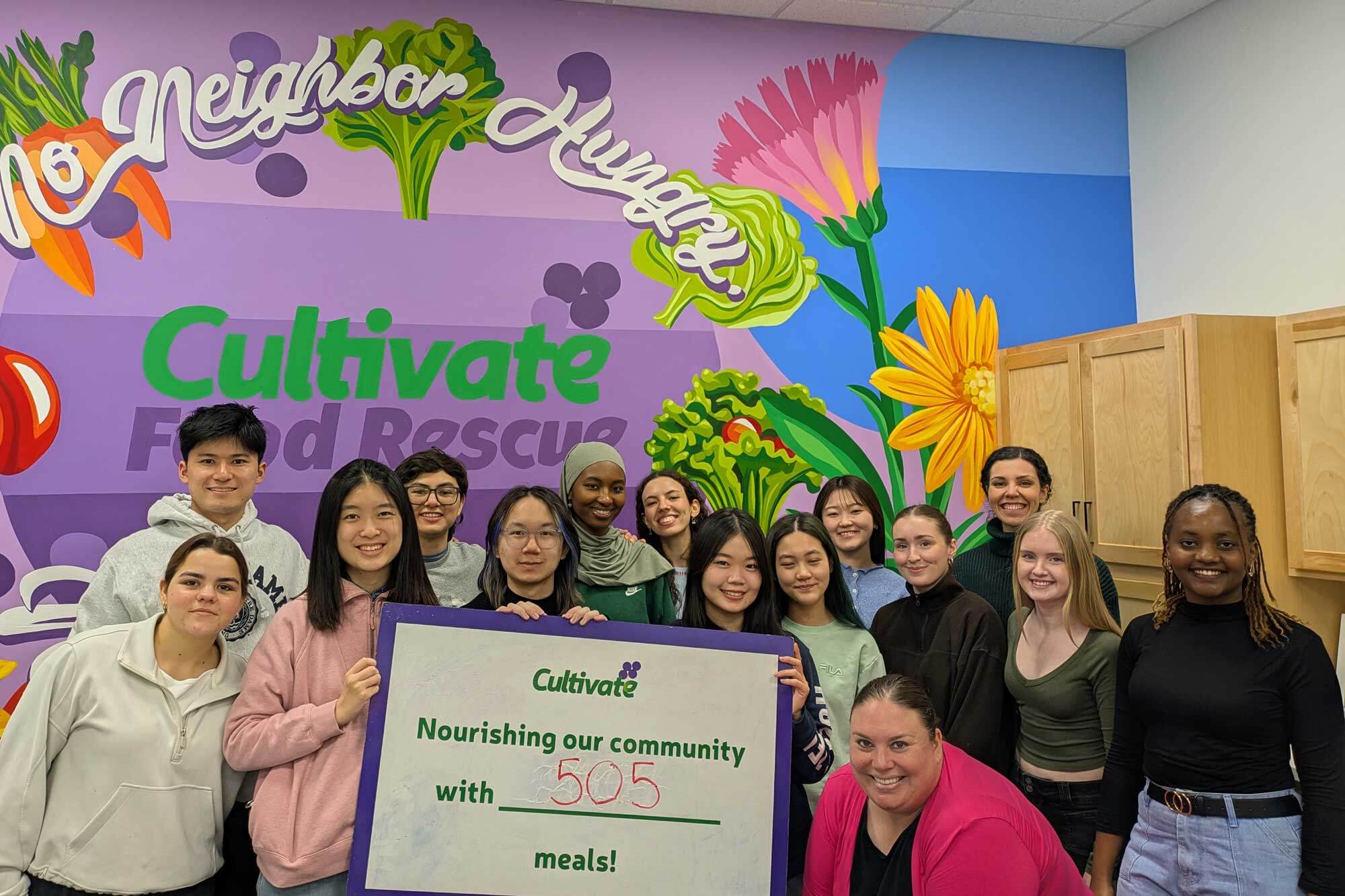
As part of their intercultural workshop series, visiting international students and the Global Engagement Programs team tackled the topic of “awareness of others” by volunteering at Cultivate Food Rescue. Participants learned about food insecurity and made a direct impact in the South Bend-Mishawaka community by packaging over 500 meals during their shift.
London
The 15th Annual Notre Dame London Shakespeare Lecture, "Shakespeare Now (but not Hamlet)," was delivered by University of Oxford Professor of Shakespeare Studies Emma Smith. Supported by ongoing collaborations with the Shakespeare Institute, the Shakespeare Birthplace Trust, Boika Sokolova, and honoree professor, Sir Stanley Wells, the yearly Shakespeare lecture continues to nourish a growing global community of Shakespeare scholars and practitioners.
Rome
Notre Dame Rome students explored how Europe and the European Parliament work, thanks to Professor Valentina Zaffino and a visit to Europa Experience in Rome. The group explored the European Union through interactive exhibits and multimedia installations and learned how the economic and political union tackles its most important challenges.
São Paulo
At the Latin America & Caribbean Regional Alumni Meeting, held in Mexico, Thaïs Burmeister Pires, director of Notre Dame São Paulo, connected with Maria Mercedes Salmon, director of Notre Dame Mexico, and Martijn Cremers, dean and professor of finance at Notre Dame's Mendoza College of Business. The three discussed insights on the growing opportunities for business education in their respective countries as well as ways to strengthen bridges between Latin America and Notre Dame.
Hong Kong
Catherine Leung, director of Notre Dame Hong Kong, showed some of Notre Dame's international partners around the city during the Asia-Pacific Association for International Education (APAIE) conference and also took part in the University of Hong Kong's annual partner day alongside staff from the #1-ranked university in Asia.
Mumbai
Michael Pippenger, vice president and associate provost for internationalization, visited India, meeting with several of Notre Dame Mumbai’s key academic partners across the country, including leaders from Miranda House College, St. Xavier’s College Mumbai, IIT Delhi, and IISc Bengaluru. He also served as the chief guest at the launch of TISS Global. The visit included meetings with the Archbishop of Mumbai and gatherings with Notre Dame alumni and parents, strengthening relationships and exploring opportunities for deeper academic collaboration in India.
International Student & Scholar Affairs
Led by Cynthia Reeves, ISSA's senior scholar immigration specialist, a group of the University's international scholars from Brazil, the Czech Republic, Germany, and India visited the office of Rev. Theodore Hesburgh, C.S.C., to learn more about his life and legacy at Notre Dame.
Originally published by Cory Hankins at global.nd.edu on March 11, 2026.
]]>
Cory Hankinstag:kylemore.nd.edu,2005:News/1798372026-03-10T10:50:00-04:002026-03-10T10:50:12-04:00Event with former Irish prime minister showcases how Notre Dame is helping to inform Ireland’s future
Leo Varadkar, the former prime minister of Ireland, spoke at the Keough School of Global Affairs on Tuesday, Feb. 24, about the prospect of Irish unification and the role a University of Notre Dame partnership with the Royal Irish Academy is playing in informing policy options on the island.
Former Taoiseach Leo Varadkar speaks Feb. 24, 2026, in The Forum of Jenkins Nanovic Halls.
ARINS was established in 2021 to dig into the most fundamental issues affecting the island of Ireland’s future. Through multidisciplinary research and analysis, as well as public events and dialogue, the project pursues two lines of inquiry. The first explores ways the Republic of Ireland and Northern Ireland can work better for people across two jurisdictions. The second examines constitutional options for and against the age-old question of uniting the island into one nation.
A prominent advocate of Irish unification, Varadkar said during the event at Notre Dame that he doesn’t think a united Ireland is inevitable. But he does think the Irish government should prepare for it.
“Sometimes nothing happens for decades and then it happens all of a sudden,” he said, noting that Germany was reunified less than a year after the Berlin Wall fell.
He also pointed to examples of political referendums in other countries — for Australia to become a republic, and for independence in Quebec and Scotland — that failed because voters weren’t provided with answers to all the practical questions involved.
“I think it makes sense to prepare (for unification). That doesn’t mean it’s inevitable, but it does make sense to be ready,” Varadkar said.
“That’s one of the things that’s great about the research that ARINS does,” he added. “Other people do research and do polling, but not to the same depth, not to the same detail, not to the same extent, not to the same academic rigor. I’m absolutely sure that, should events happen quickly, the work ARINS has been doing is the stuff that’s going to be pulled off the shelf.”
Colin Barr, director of the Keough-Naughton Institute and professor of modern Irish history, leads the conversation on Feb. 24, 2026.
Irish unification would require answers and empirical data for a multitude of questions about a new state. What would be its government structure, official language, flag and national anthem? Would citizens in the north have the option to retain British citizenship? How could the two jurisdictions merge or maintain their separate health services, education systems and police forces? What would happen to pensions in the north if Northern Ireland left the United Kingdom? How much would it all cost, and how would that price be paid?
Furthermore, even if voters passed a referendum on unification, a strong minority in Northern Ireland would likely oppose leaving the United Kingdom. How could a new state ensure the minority accepted such a result?
“I don’t want there to be a million British people in a united Ireland not feeling that this is their country,” Varadkar said. “The success of a country is often judged by how it treats its minorities, so I want to make sure that we think about ways that we can ensure minority acceptance and minority consent if there is a ‘yes’ vote.”
The growing impact of ARINS
ARINS has already had a significant impact in just the five years since it launched.
More than 140 authors have written peer-reviewed research published by ARINS and other partners to inform academics, practitioners and policymakers. The project has also provided briefings to most major political parties on the island of Ireland, to the British and Irish governments, and to the British and Irish parliaments.
“For and Against a United Ireland,” a book commissioned by ARINS and published in 2025, has landed on bestseller lists and won acclaim while also serving as a model of civil dialogue.
ARINS is neutral on whether there should be a referendum on Irish unification and takes no position on what the outcome of such a referendum might be. The project has convened more than 100 events with a wide variety of elected officials, scholars and cultural leaders who together hold a balance of views on the subject.
Lynn Scarff, executive director of the Royal Irish Academy
Lynn Scarff, executive director of the Royal Irish Academy, said ARINS is about bringing people together.
“From the academy’s perspective, its role and its job is to bring expertise in at an early stage to explore those tough questions,” she said. “The fundamental premise is that everybody is entitled to make an informed decision.”
Patrick Prendergast, chair of the ARINS executive board and former provost of Trinity College Dublin, added that the project is multidisciplinary by necessity. While some questions about the island’s future concern politics and government, other important issues involve energy use and the environment, for example.
ARINS is well known on the island for its polling with the Irish Times on attitudes toward various aspects of Irish unification. But, Prendergast said, the project is also investigating questions about making the island work better for everyone, north and south, regardless of the unification debate.
“Lots of things can happen without the need to resolve the constitutional question,” he said. “When I look at some of the polling, that’s what people often say — let’s have a better health service, north and south, let’s have an education system that’s more integrated, north and south.”
ARINS Chairman Patrick Prendergast, left, and Pauric Dempsey, executive director of the Keough-Naughton Institute's Dublin office
Pauric Dempsey, executive director of the Keough-Naughton Institute’s Dublin office and one of the founders of ARINS, noted that many of Ireland’s institutions are from the 19th century and early 20th century. This is an opportunity to look ahead to the 22nd century and think about how things could be done differently.
“This is not a unification project. This project is looking at how to imagine a better future,” Dempsey said.
“That’s a compelling thing to do,” he added. “This project is about Ireland, but it’s bigger than Ireland. It’s also about the United Kingdom, it’s about Europe.”
Former Taoiseach Leo Varadkar speaks with students after the event.
Near the conclusion of the event, Varadkar observed that the unification debate is a potentially historic moment for the people of Ireland — and he emphasized people.
“It’s not about extending a political entity or merging two political entities into a new political entity,” Varadkar said. “It’s about building a state for 7 million real people who are living and breathing today, and making that state better than the two that we have currently. And that’s really exciting.”
Learn more about ARINS (Analysing and Researching Ireland North and South), a joint project of Notre Dame’s Keough-Naughton Institute for Irish Studies and the Royal Irish Academy, at arinsproject.com.
Originally published by Kevin Allen at irishstudies.nd.edu on March 02, 2026.
]]>
Kevin Allentag:kylemore.nd.edu,2005:News/1793172026-02-17T16:21:00-05:002026-02-17T16:21:37-05:00Former Taoiseach of Ireland Leo Varadkar visiting Keough School of Global Affairs as distinguished policy fellow
Leo Varadkar, the former Taoiseach of Ireland, will spend the next two weeks at the University of Notre Dame as a distinguished policy fellow with the Keough-Naughton Institute for Irish Studies in the Keough School of Global Affairs.
Leo Varadkar
Varadkar served as Taoiseach — which is the nation’s prime minister — from 2017 to 2020 and again from 2022 to 2024. One of his signature accomplishments in office came when the neighboring United Kingdom withdrew from the European Union, a move dubbed “Brexit.” Varadkar worked to prevent a hard border between the Republic of Ireland, which remains an EU member, and Northern Ireland, which is part of the UK.
“As a former head of government, Leo Varadkar brings extensive experience in policy-making and diplomacy at the highest levels. His visit to campus promises to enrich the academic and intellectual life of both the Keough School and the University,” said Mary Gallagher, the Marilyn Keough Dean and Professor of Global Affairs in the Keough School.
Varadkar’s experience with Brexit, in particular, will figure into his activities at Notre Dame this week and next week.
ARINS, Ireland and Notre Dame
Varadkar will participate in a public conversation, “ARINS, Ireland and Notre Dame,” at 4 p.m. Tuesday, Feb. 24, in The Forum in Jenkins Nanovic Halls.
The event will showcase the work of ARINS (Analysing and Researching Ireland North and South), which is a joint academic project of the Keough-Naughton Institute and the Royal Irish Academy. ARINS Chairperson Patrick Prendergast, the former provost of Trinity College Dublin, and Lynn Scarff, executive director of the Royal Irish Academy, will also join the conversation as guest speakers.
ARINS has become an important source of insights for Irish policymakers, academics and citizens since the project was established five years ago in the wake of Brexit.
The project provides nonpartisan research on and analysis of the most fundamental questions facing the island of Ireland with two primary lines of inquiry: 1) exploring how to make the island work better for citizens across two jurisdictions, and 2) examining constitutional options for and against a united Ireland.
Policy Lab: Borders and Brexit
Varadkar will also be a guest lecturer in the “Policy Lab: Borders and Brexit” course taught by Professor of Modern Irish History Colin Barr, who serves as the Thomas Moore and Judy Livingston Director of the Keough-Naughton Institute.
The course focuses on how the Irish government navigated the complexities and uncertainties of Brexit to ensure that people and goods could continue moving between the north and south on the island of Ireland.
“It’s an honor to welcome Leo Varadkar to Notre Dame,” Barr said. “Our students and faculty are looking forward to learning from his experience as Ireland’s head of government as well as the policy lessons that can be gleaned from exploring the reverberations that Brexit has had in Great Britain and Ireland.”
This is Varadkar’s second trip to Notre Dame in recent years. He was previously on campus in September 2024 during a time that coincided with a visit from Joseph Kennedy III, then the U.S. Special Envoy for Northern Ireland.
The public conversation, “ARINS, Ireland and Notre Dame,” is open to the Notre Dame community and the general public. All are welcome to attend the event at 4 p.m. Tuesday, Feb. 24, in The Forum in Jenkins Nanovic Halls.
Originally published by Kevin Allen at irishstudies.nd.edu on February 17, 2026.
]]>
Kevin Allentag:kylemore.nd.edu,2005:News/1781602025-12-19T17:57:00-05:002025-12-19T17:57:57-05:00Notre Dame receives $50 million grant from Lilly Endowment for the DELTA Network, a faith-based approach to AI ethics
The University of Notre Dame has been awarded a $50.8 million grant from Lilly Endowment Inc. to support the DELTA Network: Faith-Based Ethical Formation for a World of Powerful AI. Led by the Notre Dame Institute for Ethics and the Common Good (ECG), this grant — the largest awarded to Notre Dame by a private foundation in the University’s history — will fund the further development of a shared, faith-based ethical framework that scholars, religious leaders, tech leaders, teachers, journalists, young people and the broader public can draw upon to discern appropriate uses of artificial intelligence, or AI.
The grant will also support the establishment of a robust, interconnected network that will provide practical resources to help navigate challenges posed by rapidly developing AI. Based on principles and values from Christian traditions, the framework is designed to be accessible to people of all faith perspectives.
“We are deeply grateful to Lilly Endowment for its generous support of this critically important initiative,” said University President Rev. Robert A. Dowd, C.S.C. “Pope Leo XIV calls for us all to work to ensure that AI is ‘intelligent, relational and guided by love,’ reflecting the design of God the Creator. As a Catholic university that seeks to promote human flourishing, Notre Dame is well-positioned to build bridges between religious leaders and educators, and those creating and using new technologies, so that they might together explore the moral and ethical questions associated with AI.”
With the support of a $539,000 planning grant from Lilly Endowment Inc. awarded in October 2024, ECG spent the past year mapping the landscape of faith-informed work in AI ethics. Drawing on insights from more than 200 conversations with representatives of these various constituencies, ECG created DELTA, a Christian-inspired ethical framework that stands for Dignity, Embodiment, Love, Transcendence and Agency. The framework was launched at the inaugural Notre Dame Summit on AI, Faith and Human Flourishing in September 2025.
“Lilly Endowment’s continued support enables Notre Dame to address one of the defining questions of our time — how to guide the use of artificial intelligence with wisdom, responsibility and a commitment to human dignity,” said John T. McGreevy, the Charles and Jill Fischer Provost. “As a leading global Catholic research university with deep partnerships across technology, faith and academia, we are uniquely positioned to convene these conversations.”
“The depth of engagement and support from the wide variety of participants at the Notre Dame summit for further development of the DELTA framework was most compelling,” said N. Clay Robbins, Lilly Endowment’s chairman and CEO. “Lilly Endowment is pleased to support this effort that acknowledges the beneficial opportunities AI offers while encouraging uses of AI that align with important moral and ethical values that draw from religious insights and traditions.”
Notre Dame’s DELTA network will be organized around interdisciplinary and intergenerational communities of practice focused on education, pastoral ministry and public engagement. The communities of practice will come together to learn about and engage with the principles of the faith-based ethical framework. They will nurture relationships between those who are developing AI technology and those in education, workplaces, religious communities and a variety of public settings who must discern ethical ways to use AI.
As part of the project, ECG will launch a series of programs to encourage and support young adults to lead with convictions shaped by DELTA principles. In addition, by developing hubs in communities in Silicon Valley and the Northeastern U.S., the institute will invite tech leaders and the public to engage with DELTA principles through issue-focused events and retreats.
Each community of practice will be supported by a timely, high-impact slate of resources, programs and events that will enable and leverage sustained engagement with the DELTA framework, developing a common language and set of tools that will energize and guide conversations around the ethics of AI and its applications.
DELTA builds on collaborations already in place around technology ethics, including the University’s partnership with IBM through the Notre Dame-IBM Technology Ethics Lab.
“Here at Notre Dame, we’re committed to shaping public thought about how humans can flourish in an AI-driven world by drawing upon our Catholic and Christian tradition,” said Meghan Sullivan, the Wilsey Family College Professor of Philosophy and director of ECG and the Notre Dame Ethics Initiative. “With this work, Notre Dame and ECG will deepen our mission to grow networks of corporate leaders, faith leaders, educators, storytellers and others to advance ethics and the common good. Given the monumental impact that AI will have on our lives, this work is more vital than ever.”
Those interested in staying connected with DELTA and this work may visit ethics.nd.edu/DELTA to join the DELTA mailing list.
Notre Dame has always focused on ethics in both research and formation. In 2024, the University intensified its commitment to the field with the launch of the University-wide Ethics Initiative, which aims to establish Notre Dame as a premier global destination for the study of ethics, offering superb training for future generations of ethicists and moral leaders, a platform for engaging the Catholic moral tradition with other modes of inquiry and an opportunity to forge insights into some of the most significant ethical issues of our time.
A signature element of the Ethics Initiative, the Institute for Ethics and the Common Good facilitates interdisciplinary research in foundational and applied ethics, coordinates projects that cross departments and units and supports ethics-related education and public engagement efforts.
Lilly Endowment Inc. is a private foundation created in 1937 by J.K. Lilly Sr. and his sons Eli and J.K. Jr. through gifts of stock in their pharmaceutical business, Eli Lilly and Company. While those gifts remain the financial bedrock of the Endowment, it is a separate entity from the company, with a distinct governing board, staff and location. In keeping with the founders’ wishes, the Endowment supports the causes of community development, education and religion and maintains a special commitment to its hometown, Indianapolis, and home state, Indiana. A principal aim of the Endowment’s religion grantmaking is to deepen and enrich the lives of Christians in the United States, primarily by seeking out and supporting efforts that enhance the vitality of congregations and strengthen the pastoral and lay leadership of Christian communities. The Endowment also seeks to improve public understanding of religion and lift up in fair, accurate and balanced ways the roles that people of all faiths and various religious communities play in the United States and around the globe.
Contact: Carrie Gates, associate director of media relations, 574-993-9220, c.gates@nd.edu
Originally published by Carrie Gates and Laura Moran Walton at news.nd.edu on December 19, 2025.
]]>
Carrie Gates and Laura Moran Waltontag:kylemore.nd.edu,2005:News/1770092025-12-05T10:42:00-05:002025-12-05T10:42:01-05:00University of Notre Dame and Abbey Theatre sign historic partnership agreement
DUBLIN, IRELAND — The University of Notre Dame and the Abbey Theatre today signed a Memorandum of Understanding establishing a formal partnership to advance Irish performing arts through education, production, and cultural exchange. The agreement was signed at the Merrion Hotel in Dublin, marking a significant milestone in the relationship between two institutions committed to celebrating and advancing Irish culture.
The partnership centers on two major initiatives: the Abbey Theatre's curation of theatrical content for Notre Dame's Threshold Festival at Kylemore Abbey in August 2025, and the development of innovative theatre education programs combining hands-on learning at Kylemore with professional experiences at the Abbey Theatre in Dublin.
"This partnership represents an exciting convergence of artistic excellence and educational opportunity," said Lisa Caulfield, director of Notre Dame Kylemore. "By bringing together the Abbey Theatre's century-long tradition of dramatic excellence with Notre Dame's commitment to fostering cultural exchange in the West of Ireland, we are creating transformative experiences for students, artists, and audiences on both sides of the Atlantic. The success of our collaboration on last summer's Threshold Festival demonstrated the tremendous potential of this partnership, and we are thrilled to formalize our commitment to advancing Irish performing arts together."
The signing ceremony was attended by Abbey Theatre leadership, including Mark O'Brien, Chief Executive, and Marie Lawlor, Deputy Chief Executive. Also present in the audience was Dr. Michael Pippenger, vice president and associate provost for internationalization, along with adjunct faculty member for Notre Dame’s Creative Writing Summer Seminar course and Abbey Theatre contributor, playwright, and lecturer Marina Carr.
Businessman and philanthropist Martin Naughton, whose support has been instrumental to both institutions, attended the ceremony and expressed his enthusiasm for the collaboration. "I am absolutely delighted to see this agreement signed today, bringing together two great Irish institutions," Naughton said. "My wife Carmel serves on the advisory council of the DeBartolo Performing Arts Center at Notre Dame and is a patron of the Abbey Theatre, so we have watched with great interest as these two organizations have found common ground. This partnership represents the beginning of something truly special—a transatlantic bridge that will enrich Irish performing arts and create extraordinary opportunities for the next generation of artists and students."
Michael Pippenger, vice president and associate provost for internationalization, emphasized the strategic importance of the partnership: "This collaboration with the Abbey Theatre exemplifies Notre Dame's commitment to fostering meaningful global partnerships that advance both education and cultural understanding. By connecting our students, faculty, and the wider Notre Dame family with one of Ireland's most prestigious cultural institutions, we are creating opportunities for transformative learning experiences that bridge academic study with professional practice in the performing arts. This partnership strengthens our presence in Ireland and deepens our engagement with Irish culture in ways that will benefit our entire community for years to come."
"This partnership takes shape in the broader context of Notre Dame's reinvigorated commitment to the arts through the Arts Initiative, an historic investment in interdisciplinary arts research and creative practice. Collaboration among faculty, students, local communities, and arts organizations in the University's global network is key to the success of the project. This agreement with the Abbey Theatre stands as a prime example of that kind of collaboration and promises to advance impactful programming and instruction in the most interdisciplinary of artforms—theatrical performance," says Michael Schreffler, director of the Notre Dame Arts Initiative, associate dean for the Arts in the College of Arts and Letters, and Art History professor in the Department of Art, Art History & Design at Notre Dame.
Founded in 1904, the Abbey Theatre is Ireland's national theatre and has played a pivotal role in Irish cultural life for over a century. The Abbey is committed to imaginatively engaging with Irish society through the production of ambitious theatre and the development of new voices in playwriting, directing, and performance.
About Notre Dame Kylemore
Since 2016, Notre Dame Kylemore has served as a hub for educational and cultural exchange in the West of Ireland. Located at the historic Kylemore Abbey in Connemara, County Galway, ND Kylemore offers immersive learning experiences that connect students with Irish history, culture, and contemporary society while fostering meaningful collaborations with Irish cultural institutions.
Media contact:
Lisa Caulfield
Director, Notre Dame Kylemore
Kylemore Abbey, Co. Galway
lcaulfield@nd.edu
]]>
Notre Dame Kylemoretag:kylemore.nd.edu,2005:News/1769962025-12-03T07:57:00-05:002025-12-03T07:57:01-05:00‘Recognizing Christ in the vulnerable’: University President Rev. Robert A. Dowd, C.S.C., celebrates Mass for immigrants and immigration reform
On Monday evening (Dec. 1), Rev. Robert A. Dowd, C.S.C., president of the University of Notre Dame, presided and preached at a Mass for immigrants and immigration reform at the Basilica of the Sacred Heart. The Mass was held in response to a special message published Nov. 12 by the United States Conference of Catholic Bishops, in which the bishops expressed opposition to “the indiscriminate mass deportation of people” from the U.S., as well as to recent comments by Pope Leo XIV.
The beginning of Advent, Father Dowd noted in his homily, was a fitting time to celebrate the Mass.
“Advent is a season when, in a special way, we are called to prepare a place for the Lord Jesus in our hearts, in our minds, in our lives and in our communities,” Father Dowd said. “Advent is also a season when we are called to develop insight — a ‘holy insight’ — that allows us to recognize the Lord Jesus as he comes to us.”
Father Dowd observed that Jesus “comes to us in ways that are stunning for their ordinariness.” Referencing the Mass’ first reading from the book of Deuteronomy, he said that God’s people are to be especially attentive to the vulnerable in their midst, for “God continues to come to us in flesh and blood, especially the flesh and blood of those who struggle the most.”
“While there are many vulnerable people in our midst here in our country and elsewhere in our world — and we Christians are called to recognize Christ present in them all — this evening, as members of the Notre Dame family, we join with our Holy Father, Pope Leo, and our bishops to pray that we might recognize Christ present in our immigrant population, many of whom are especially vulnerable these days,” Father Dowd said.
Father Dowd noted that “it is important to recognize the right and responsibility of governments to decide who, when and how to allow people into a country, including this one.”
“There can be no doubt our immigration system in this country is broken, and has been for some time,” he said. “There is need for reform.
“However, it is imperative that we treat people who are in this country — many for several years, contributing to and enriching our country — with the respect that their God-given dignity demands.”
University of Notre Dame President Rev. Robert A. Dowd, C.S.C. visits the Grotto after a Mass for Immigrants and Immigration Reform at the Basilica of the Sacred Heart. (Photo by Michael Caterina/University of Notre Dame)
Father Dowd exhorted the hundreds of attendees to consider how the Notre Dame community can work together to address the brokenness of the immigration system.
“At Notre Dame, we must do more than complain. We must deepen our understanding of the complexity of the situation and work with others to propose sensible and humane solutions,” he said. “That’s what universities are for.”
Father Dowd concluded his homily with a call to pray for immigrants, for “sensible and humane immigration policy reform” and for “elected leaders and all who have the responsibility of governing and enforcing our country’s laws.”
“And, let us pray that those of us who call ourselves Christians might be cultivators of hope by recognizing Christ in the vulnerable, serving him there, learning from him there and standing with him there,” he said.
“May Notre Dame always be a community dedicated to growth, not only in knowledge, understanding and technical expertise, but in wisdom and insight — the holy insight to recognize the mysterious presence of Christ in our midst.”
Rev. Gerard J. Olinger, C.S.C., vice president for student affairs, closed the Mass with an invitation to join Father Dowd and himself in prayer at the Grotto, “to light a candle and to ask for the intercession of Our Lady as we navigate these conversations as a nation.”
Contact: Carrie Gates, associate director of media relations, c.gates@nd.edu, 574-993-9220
Originally published by Carrie Gates at news.nd.edu on December 02, 2025.
]]>
Carrie Gatestag:kylemore.nd.edu,2005:News/1766282025-11-18T12:56:00-05:002025-11-18T12:56:44-05:00Sustainability Research Fellows present findings on sustainable practices from Europe
On October 30, 2025, the Nanovic Sustainability Research Fellows came together to share their findings from their semester-long research projects conducted across Europe. This session was chaired by Eamon Ryan, Ireland’s former Minister for the Environment, Climate, and Communications (2020–2025), who was visiting the University of Notre Dame over several days visiting classes, meeting students and faculty, and presenting a public lecture on Monday, November 3. The students brought perspectives on sustainability from Ireland, London, and Rome back to the United States and the Notre Dame campus.
Student presentations were evaluated by a panel of judges, which included Eamon Ryan, Brigitta Richmond (Notre Dame Global), and John Kalemkerian (Office of Sustainability). Of the ten total presentations, the judges named both the Green Globe Award recipient for best presentation and an honorable mention.
Winner: Isabelle Wilson
Isabelle Wilson received the Green Globe Award for her presentation, "Urban Agriculture & Carbon Neutrality: From Ancient Rome to Modern Lazio."
Wilson is a senior at the University of Notre Dame studying global Affairs and philosophy. She spent the spring at John Cabot in Rome, Italy, with the help of the Nanovic Institute, researching how urban farming initiatives can simultaneously address environmental sustainability challenges and empower local communities.
Honorable Mention: Gracie Speicher
Gracie Speicher received an honorable mention for her presentation, "Public Spaces and the Tiber River, Rome."
Speicher is a senior environmental science and Italian student at the University of Notre Dame. This past spring, she conducted research on water quality and public spaces along the Tiber River in Italy with the help of the Nanovic Institute Notre Dame Rome. Since then, she has also worked with the Geography Department at Trinity College Dublin conducting water quality analyses of streams entering South Dublin Bay.
Presenters:
Christine Hruby presented“Clear Water, Clear Future: Evaluating Water Quality Across Ireland," following her work during her spring abroad in Dublin, Ireland.
Jack MapelLentz presented his findings on “Water Quality in Cavan & Monaghan: a monitoring program implemented by citizen science,” after his spring abroad in Dublin, Ireland.
Rika Felten presented “Ireland’s Offshore Wind Journey and What the US Can Learn,” sharing what she learned during her spring abroad in Dublin, Ireland.
Sara Wheeler presented her discoveries on “Dereliction and Decline: The Economic and Social Costs of Ireland’s Dereliction Crisis,” after spending her spring in Dublin, Ireland.
Sean Bocan, Isabelle Donofrio, and Greg Gehring presented “Sustainable Development and Leadership Goals: Working to reduce coffee-cup waste & consumption at ND London,” sharing their findings from their spring abroad in London, England.
India Byrne presented what she discovered about“Investing in Our Future: ESG Investing in the EU,” during her spring abroad in Rome, Italy.
Josh Williams presented his insights on “The Case for Regulatory Intervention in the Plastics Industry,” based on what he learned from spending the spring abroad in Galway, Ireland.
Elise Wollemborg presented her findings on “Sustainable Healthcare in Ireland: The Environmental Impacts of the Shift towards Community Based Care,” after spending her spring abroad in Galway, Ireland.
The Nanovic Institute congratulates all the Sustainability Fellows on their successful research. Each presentation reflected impressive dedication and initiative, making the judges’ decisions especially challenging. Even the catering for the event played a role in building sustainability, with measures such as asking participants to bring their own cups and forgoing plasticware to reduce waste.
We thank each student for their efforts, and we hope this was an impactful and eye-opening experience for all its participants. In the future, the institute plans to post the students' findings in an online forum currently being designed.
Applications for the 2026 Study Abroad Sustainability Fellows program have already been collected and are under consideration. The institute looks forward to a second year of collaboration, excellent research, and a shared interest in building a more sustainable future. It also thanks its partners at Notre Dame Global, including Notre Dame London, Notre Dame Dublin, Notre Dame Galway, Notre Dame Rome, and others, as well as partners at Notre Dame Sustainability.
Originally published by Morgan Engates at nanovic.nd.edu on November 10, 2025.
]]>
Morgan Engatestag:kylemore.nd.edu,2005:News/1759472025-10-21T10:03:04-04:002025-10-21T10:03:04-04:00A Q&A with memoir-writing workshop participant, Theresa Southam
This fall, Notre Dame Kylemore hosted an exciting opportunity for writers: a memoir-writing workshop with award-winning author, columnist, and speaker Heather King. The workshop consisted of talks, discussions, prompts, and plenty of quiet writing time. Attendees described the workshop as "rich and deep" and "steeped in Irish culture, geography, weather, and food."
To get a full picture of the week, Emma Kirner, the research programmes manager at Notre Dame Kylemore, spoke with participant Theresa Southam about her experience attending the workshop. Southam is the department head of the Teaching and Learning Centre (TLC) at Selkirk College, an associate faculty member at Royal Roads University, and a Fielding ISI Fellow. Their conversation has been edited for length and clarity.
Could you start by telling me a little about yourself and your background as a writer?
Theresa Southam: I came to writing early and late. In my early twenties, I attended a writing school in the region I now call home—Nelson, BC, Canada. I took that experience into my environmental conservation work. However, publication came only a few years ago through a small university press—Fielding, I have coedited a volume for them and recently published my own book.
What themes or forms do you usually explore in your work—and did this workshop deepen that practice, or open up something new for you?
TS: I am interested in how older women in more individualistic cultures like the United States and Canada are often misunderstood and misrepresented. However, ageism is just one ‘ism’ that troubles me deeply. I am also concerned about colonialism, racism, and other oppressions that are prevalent today. My book is about how we can make a difference by joining social movements that seek to change the world, such as #LandBack, ecofeminism, peace, multiculturalism, and eldering. Each chapter tells the story of an individual who has overcome their own trauma and contributed significantly to social change.
What drew you to this retreat in the first place?
TS: I am working on a new book. As part of my first book, it was suggested that I write memoir as a way of being present for the reader—the real human behind what could have been an overly academic text. Memoir helps me understand what is driving me to do this incredibly hard thing—write a book. I got deeply into the purpose of the next book while at Kylemore.
Spirituality is an inherent thread in this retreat—did that aspect influence your decision to join, or shape your experience in any way?
TS: To be honest, I didn’t understand how spiritual this workshop would be! The workshop leader, Heather King, has this uncanny ability to hold the space for writers at all levels to explore some deep traumas, safely, and without being a group therapy session!
What makes Heather the right guide for this program?
TS: The prompts really worked for me, as did the wonderful stories and quotes that Heather shared each day. She has crafted this balanced program where writing advice is interwoven with writing time, walking time, meals, and sharing. Heck, we even had movie nights!
How were your days structured during the retreat?
TS: I stuck to the program—attending the writing advice sessions, finding a beautiful window to sit beside and write myself, listening to others, and, probably most importantly, taking long walks on the grounds and enjoying the exceptionally fresh and delicious food!
Did your time at Kylemore have a meditative quality for you? What was the most meaningful part of it?
TS: My time felt contemplative. I didn’t feel lonely because of the sessions and the communal meals, but there was time for transcendent experiences in the woods, at the chapel, or just gazing out at the lake. I loved hearing the other participants read their work. I’m not sure if this happens every time, but the vulnerability in the group was exceptional. I made some acquaintances who I hope will become friends. A month later, we are still in communication as a group, encouraging each other and keeping up with what happens next! I loved the Kylemore staff as well—special people all of them!
For fun—what books are currently on your bedside table?
TS: Ooh. I very much want to read Helm by Sarah Hall! I’m reading the Empire of AI by Karen Hao, which shows how artificial intelligence began for the social good and, through greed, has evolved into a mostly destructive technology benefiting a few elite and wealthy people. The way AI is going now, this technology will further exacerbate bias, untruths, and worldviews that are generally harmful. People really need to learn about local language models (LLMs) like Aiden and start building LLMs themselves. Sneak peek for you: my next book is about how people can engage in AI that is more authentic and truthful. For something a little less expansive, I’m also reading everything that Elizabeth Strout has ever written—which is a lot! A reviewer was right in saying that she embodies radical empathy on each and every page!
Interested in attending next year's workshop? Learn more and apply on the Notre Dame Kylemore website.
]]>
Emma Kirnertag:kylemore.nd.edu,2005:News/1756592025-10-10T08:13:00-04:002025-10-10T08:13:40-04:00Telling stories from the Shannon Seminar on Storytelling
Remotely nestled within Connemara in the west of Ireland lies Kylemore Abbey, a place with its own storied history. For the purposes of this story, it becomes the setting of a unique, insightful, and productive academic experiment.
In conjunction with the Laura Shannon Prize in Contemporary European Studies, the Nanovic Institute for European Studies hosted the Shannon Seminar on Storytelling, an academic working group that invited a variety of scholars to contribute papers reflecting on the theme of “storytelling on the margins,” examining how voices from diverse perspectives considered “marginal” in society might share their stories, for a forthcoming edited volume. The working group met throughout the 2025 spring semester to present and give feedback on each other’s works in progress. In the following summer, the seminar culminated in a writing workshop at Kylemore Abbey, where participants discussed and gave feedback on completed first drafts. Situated in Ireland’s rural west, the group explored storytelling in myriad and diverse forms quite literally from the margins of Europe.
I was fortunate enough to be one of the graduate students invited to participate in the seminar, and it was one of the most unique and career-building experiences I have had. I am currently a second-year master’s student in the English department. At the time of the seminar, I had just finished my first year of graduate school, making me the most junior scholar in the group, which, at first, was rather intimidating. The setting of the seminar, however, quickly lent itself to assuaging those insecurities.
Tara Zahra (left) and Meredith Dincolo (right) at the Naughton Commons at Kylemore Abbey.
The seminar was centered around a series of feedback sessions in which each scholar had the chance to briefly present their paper and receive feedback from other writers to generate ideas for future drafts. The session where I presented my paper, which explored the feminist fantasy writings of Irish author Deirdre Sullivan, was amazingly generative, and now, I feel like I have enough ideas about different directions I could take to fill a book. My session also made me feel like I was treated as a peer to the other participants of the seminar, most of whom were tenure-track or tenured professors or professional practitioners of the arts (more on that later). Likewise, in the feedback sessions where I was contributing ideas to other writers, my contributions were taken seriously as generative points of discussion.
I call the seminar experimental because of the unusual format it followed. While not marginal by any means in the sense of the organizations sponsoring it or the caliber of scholarship, it could be considered on the margins of the academy for how it brought together scholars in a “formally informal” setting to create a publication in process which is being shaped by the distinctive methods through which the final product is coming together. In my experience, discussions of papers or works in progress take place either in the classroom, typically in a graduate seminar, or at formal conferences. The former is a learning experience for students in which there is an inherent hierarchy. The professor runs the classroom as the expert on the topic being discussed to impart knowledge and guide discussion. The latter sees a presenter giving an extended, formal presentation as the expert of their finished paper to an audience of other experts who will then ask questions in an organized question-and-answer session.
"[This seminar] was a truly interdisciplinary and productive creation of new knowledge."
The Shannon Seminar was neither of these things. It had a collegial setting reminiscent of a classroom in the sense that papers were under discussion as works in progress instead of being the objects of extended presentations; however, there was no inherent hierarchy drawn from expertise and experience like that of a professor and student. Instead, the goal of the feedback sessions was exploration and possibility, and everyone contributed to stimulating and generative discussions that opened new avenues of inquiry for each paper.
Cecelia and fellow conference members in the ballroom at Kylemore Abbey.
These discussions extended beyond the sessions themselves to excursions and meals where more informal, yet still fruitful conversations took place. As an early-stage graduate student, I had the unique opportunity to spend a week receiving mentoring from a diverse array of scholars who both helped me improve my own paper and gave great advice for pursuing a career in academia. At the same time, I was treated as a peer within the group who actively contributed to shaping everyone’s scholarship through participation in both formal and informal colloquia.
The interdisciplinary range of the scholarship in this seminar also extended to the practice of art. Instead of writing an article, Olivier Morel, associate professor of film studies, screened the work-in-progress version of a short documentary that he is planning on completing in the near future. Tara Zahra, Hanna Holborn Gray Professor of East European History and the College at the University of Chicago, is working with Meredith Dincolo, professional dancer, teacher, and choreographer, on an article about contemporary dance in 1990s Europe. They gave a practicum on the foundations of dance and movement studies.
Jacob Kildoo with Katriona O'Sullivan, author of Poor.
We also had authors Ananda Devi, who wrote a short story for the event, and Katriona O’Sullivan, professor of psychology at Maynooth University, give talks about their most recent books and their writing processes. As a literary scholar, listening to Devi and O’Sullivan’s talks and then having the chance to discuss their work with them over the course of the seminar was a particular highlight for me. On a more general note, having these practitioners contribute to the seminar and the creation of new knowledge for the edited volume pushes the bounds of traditional academia by combining art and scholarship to explore different modes of storytelling.
The people, the place, and the unusual format made the Shannon Seminar unlike anything else I have experienced in academia, and I believe it was a truly interdisciplinary and productive creation of new knowledge. It allowed for the exploration of ideas many of us might not otherwise have had a forum to work with so deeply. Looking ahead, I know my scholarship and article have been reshaped for the better, and I cannot wait to see what type of volume this successful experiment will yield.
Originally published by Cecelia Swartz at nanovic.nd.edu on October 09, 2025.